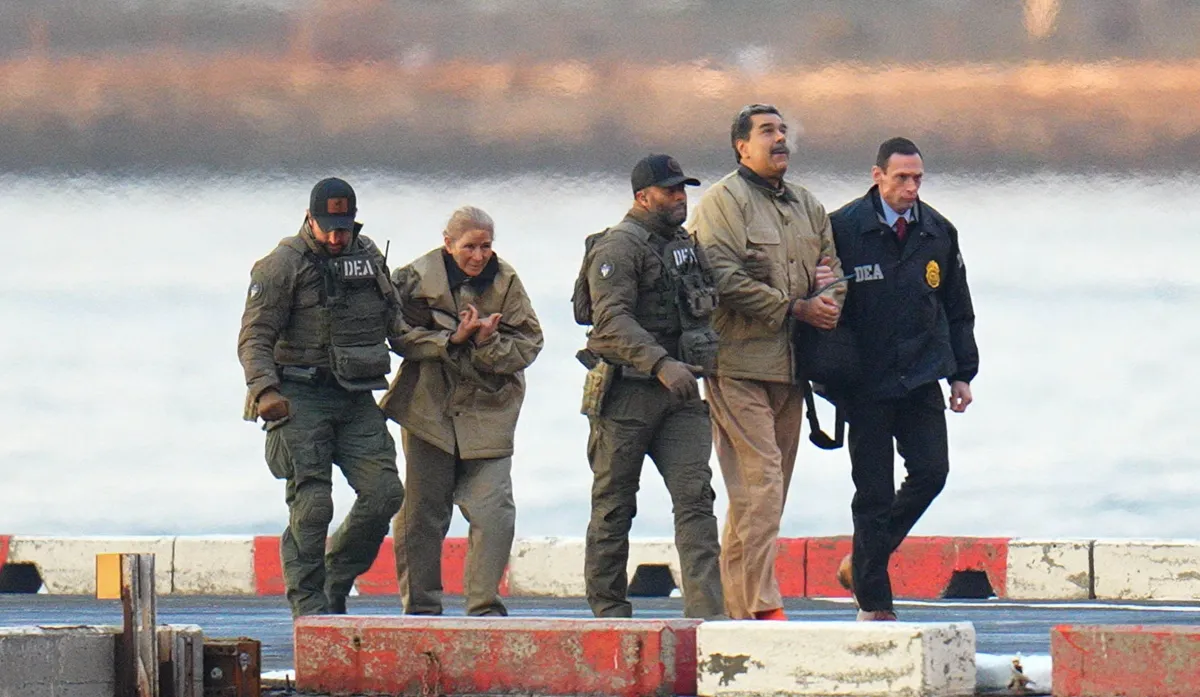
Following the analysis presented in the column “Operation Absolute Resolution and the American internal conflict,” we will take as our starting point the operation that took place on January 3, 2026. This episode was responsible not for a rupture, but for an important strategic repositioning of the United States on the geopolitical chessboard of the Americas—or, as they call it, the Western Hemisphere. In this sense, it is important to emphasize the term “strategic repositioning” as the position adopted by the cabinet of current President Donald Trump is only one chapter in a complex and multifaceted relationship between the United States (US) and Latin America and the Caribbean (LAC).
To better understand how the episode of the capture, arrest, and deposition of the then-president of Venezuela, Nicolás Maduro, and his wife, Cilia Flores, fits into the spectrum of US-LAC relations, it is necessary to understand the historical panorama of relations between the regions that make up the American continent and the resurgence of the Monroe Doctrine as a foreign policy instrument during the first (2017-2021) and second (2025-present) administrations of President Donald Trump.
The 2025 National Security Strategy
Amid the intensifying diplomatic crisis between Washington and Caracas in the second half of 2025, the White House released its National Security Strategy (NSS) on November 5, 2025. This document is published at the end of the first year of each new US presidential administration and sets out the presidential cabinet’s view of the global political landscape, how the country positions itself amid changes in the geopolitical situation, and where it wants to be in the short to medium term.
Therefore, the NSS is a document of utmost importance for the organization of the country’s internal bureaucratic apparatus. In other words, based on the objectives and priorities outlined in the document, the main government agencies must outline their strategies and priorities in order to achieve their respective national objectives. This is because, although the NSS mainly deals with political, economic, and military issues, it also addresses related topics that are important for national security, such as innovation, technology, and energy independence. In addition, the US National Security Strategy can be a valuable tool in analyzing how the country perceives the global and regional security landscape and, more importantly, what are the main threats detected and generally ranked in a strategic priority list.
With regard to a comparative analysis between the 2017 NSS, during Donald Trump’s first term, and the 2025 NSS, we can see an evolution in a discourse that was already assertive in 2017. This is because it presented a reading of global politics as a scenario of a return to multipolarity, uncertainty, and insecurity in an increasingly interdependent and complex world, in which US leadership in the liberal world order—an order established by the US itself after World War II — would be at risk and strongly threatened by major adversarial powers, such as Russia and China, to a more reactive stance in response to the questioning of American leadership. It is at this point that Latin America and the Caribbean, which previously played a secondary role in the 2017 NSS, take on a priority role in ensuring the national security of the United States. In the 2025 document, there is a section dedicated to listing the main foreign policy interests of the Trump II administration, in which the Western Hemisphere appears as the first region discussed, and its subtitle, “Western Hemisphere: The Trump Corollary to the Monroe Doctrine,” quickly sets the tone for the relationship between neighboring regions.
Under the premise that stability and good governance in the Western Hemisphere will contribute to national security by reducing mass migration to the United States and combating the negative effects of narco-terrorism and other transnational criminal organizations on the country’s economy and health. In addition, the document also highlights the US government’s desire to contain and prevent Latin American countries from associating with countries outside the region, particularly with regard to the ownership of assets that are essential for maintaining supply chains critical to the functioning of the US economy. The notion that the stability and security of the regions are directly connected is also present in the speech by Secretary of State Marco Rubio, who stated that the Western Hemisphere “belonged” to the United States and that they would not allow the region to serve as a base for the operation of adversaries, competitors, and rivals to US interests. This conception that the US is the only power—according to them—that can interfere in Latin America and the Caribbean is not something new in the history of US foreign policy. The return of geopolitical competition between great powers has brought with it the division of the world into zones or areas of influence. Below, we will briefly recap when and how LAC became the classic geopolitical area of influence of the US.
From the Monroe Doctrine to the Trump Corollary
Although the concept of National Security only appeared in the American vocabulary during World War II, the premise that the security of the United States could only be guaranteed through the security and stability of the hemisphere as a whole was present in the country’s foreign policy long before that, at the beginning of the 19th century. At that time, US foreign policy was fundamentally guided by isolationism, meaning that the country avoided involvement in external disputes and conflicts—Europe at that time was divided in an intricate game of alliances that permeated the period of the Napoleonic Wars (1789-1802)—and focused its attention on resolving internal conflicts. However, no country can completely isolate itself from the international community, especially in times of conflict. Therefore, in 1823, US President James Monroe decided to adopt a neutral but still strategic diplomatic stance of not getting involved in foreign affairs, provided that, in return, no European power interfered in his country’s affairs, extending the region of non-intervention to the central and southern parts of the Americas, protecting the entire hemisphere from European incursions.
Although the US did not yet have the military capabilities to defend the entire Western Hemisphere from foreign attack, the Monroe Doctrine was the first spark of a more assertive stance by the United States and the “seed” of future US imperialism. A few decades later, in 1890, US Navy officer Alfred Thayer Mahan published his book “The Influence of Sea Power upon History” – which, over time, became one of the works that gave rise to one of the theories of classical geopolitics, the theory of maritime power. In it, Mahan argues that Americans should take advantage of their main strategic advantage, their insular position. After expanding westward and conquering territories that had previously belonged to Mexico, the US achieved a rare feat: establishing national borders from one end of the continent to the other, reaffirming its control over the east coast and gaining control of the west coast, with access to the Atlantic and Pacific Oceans.
Therefore, Mahan argued that the United States should eclipse the British navy in the Western Hemisphere and, from there, project power through the expansion of its naval forces and merchant fleets. Far from the main centers of global tension and having “overcome” internal divisions with the end of the Civil War (1861-1865), the US had the perfect opportunity to expand its immediate sphere of influence beyond its borders, and Latin America and the Caribbean would become part of the “American fortress,” thus enabling the Americans to assume their position of regional hegemony.
The Mahanian approach had a strong influence on the American government and intellectual elite, even inspiring President Theodore Roosevelt (1901-1909) in what would come to be called in 1904 the Roosevelt Corollary to the Monroe Doctrine. In it, the president reinforced the United States’ duty to defend the hemisphere from the imperialist policies of extra-regional powers in exchange for its exclusive (self-declared) right to intervene in the region. At the time, Roosevelt justified his new foreign policy with arguments such as Latin America’s cultural backwardness and the civilizing mission, also known as Manifest Destiny, that the US had a divine duty to bring democracy to the rest of the world. More than 120 years later, the justifications have changed, but the goal remains the same: to maintain control of the Western Hemisphere, especially in times of global insecurity.
But what about the Trump Corollary? Even before the announcement of the corollary in the 2025 NSS, there was speculation about the return of the Monroe Doctrine as a rhetorical device to reaffirm the United States’ position in Latin America during Donald Trump’s first administration. This speculation gained momentum in 2019 when then-Secretary of State Mike Pompeo stated that the US would spare no effort to restore democracy in the hemisphere, in clear opposition to the Maduro government and reiterating the US government’s accusations of fraud in the 2018 Venezuelan elections. It is worth noting that during the Obama administration, Secretary of State John Kerry had declared the end of the Monroe Doctrine in 2013, marking a new era of cooperation and partnership between the regions. This brief interlude of the Monroe Doctrine came to an end with the election of Donald Trump to the presidency and the threat already in his first year in office, 2017, when the president stated that he did not rule out the possibility of military intervention in Venezuela in response to the Caribbean country’s rapprochement with countries hostile to the United States, such as Russia, China, and Iran. At that time, Trump limited himself to imposing economic sanctions, threats, and anti-narcotics operations in the Caribbean Sea, near the Venezuelan coast, but in his second term, words took the form of actions between late 2025 and early 2026.
In summary, we can conclude that Venezuela already played a central role in US foreign policy toward Latin America during Trump’s first term. However, it was only during his second term that Latin America and the Caribbean took on a more prominent role in the National Security Strategy and that the president carried out the threats that had been made since 2017. Furthermore, the Monroe Doctrine was and continues to be an important tool for analyzing relations between the United States and Latin America from a historical perspective, but with contours and consequences that are still present today. It is still too early to say for sure what the Trump Corollary is, but its official announcement in the 2025 NSS was important in signaling the strategic importance of Latin America to the United States in the current scenario of geopolitical competition between major powers.
AYERBE, Luis F. Estados Unidos e América Latina: a construção da hegemonia. São Paulo: Editora UNESP, 2002.
CEPIK, Marco. O Corolário Trump e a América Latina. Revista Tempo do Mundo, vol.5, n.1, p. 241-265, jan. 2019. Disponível em: https://www.ipea.gov.br/revistas/index.php/rtm/article/view/146
ESTADOS UNIDOS. The White House. National Security Strategy of The United States of America. Dez, 2017. Disponível em: https://trumpwhitehouse.archives.gov/wp-content/uploads/2017/12/NSS-Final-12-18-2017-0905.pdf#page=61.11
ESTADOS UNIDOS. The White House. National Security Strategy of The United States of America. Nov, 2025. https://www.whitehouse.gov/wp-content/uploads/2025/12/2025-National-Security-Strategy.pdf#page=19.29
FALCÃO, Débora G. A Política de Segurança dos Estados Unidos para a América Latina: o USSOUTHCOM e a securitização do Círculo Vicioso de Ameaças na Venezuela. João Pessoa, 2023. Disponível em: https://repositorio.ufpb.br/jspui/bitstream/123456789/27158/1/DGF21062023.pdf
KARNAL, Leandro. História dos Estados Unidos: das origens ao século XXI. São Paulo: Contexto, 2007.
OLIVEIRA, Flávio R. Estados Unidos da América: a segurança em perspectiva histórica. In: DINIZ, Eugenio. Estados Unidos: política externa e atuação na política internacional contemporânea. Belo Horizonte: Editora PUC Minas, 2009.
TEIXEIRA JUNIOR, Augusto W. M. Geopolítica: do pensamento clássico aos conflitoscontemporâneos. Curitiba: Intersaberes, 2017.
The return of the Monroe Doctrine. The Economist, 17 set. 2020. Disponível em: https://www.economist.com/the-americas/2020/09/17/the-return-of-the-monroe-doctrine
Trump afirma que os Estados Unidos não descartam uma opçõa militar na Venezuela. BBC Brasil, 11 ago, 2017. Disponível em: https://www.bbc.com/portuguese/internacional-40907714
US Secretary of States Declares, “The Monroe Doctrine is Dead”. Americas Quarterly, 19 de nov de 2013. Disponível em: https://www.americasquarterly.org/blog/u-s-secretary-of-state-declares-the-monroe-doctrine-is-dead/