The open veins of Latin America remain as exposed wounds under new forms of imperialism, where discourses disguised as democracy conceal economic interests.
Historically, Latin America has undergone violent processes of intervention, political interference, and economic pressure aimed at subjugating the region to the interests of external powers, particularly Europe and U.S. foreign policy. This context laid the foundations of the region’s political and economic instability, in which sovereignty and local autonomy remain points of tension within regional geopolitical dynamics. Thus, the open veins of Latin America—a term introduced by Eduardo Galeano (1971)—express this sense of marks and open scars left as a consequence of the violent process of exploitation carried out by international powers, which is reflected today in the region’s structural problems.
Within this historical context, the open veins also represent the process of draining Latin American wealth toward the Global North—a scholarly concept used to designate industrialized and developed economies—thereby consolidating a structure of subordination designed to meet the economic and commercial needs of the center of global capitalism. In this way, a condition of underdevelopment is imposed on the region as a direct result of the external development of these powers, thus strengthening the prosperity of this empire.
These marks in the region’s political history remain present insofar as foreign powers—such as the United States and its national interest in politically dominating this region—persist in implementing economic and military operations in Latin America as a means of reaffirming their projection of power and political influence through coercion. Accordingly, recent events involving attacks on ships, political threats, and the subsequent kidnapping of the president of Venezuela in January 2026 raise an important warning for the entire region regarding the imperialist potential of the United States and its interest in subjugating the region to the imperatives of its foreign policy.
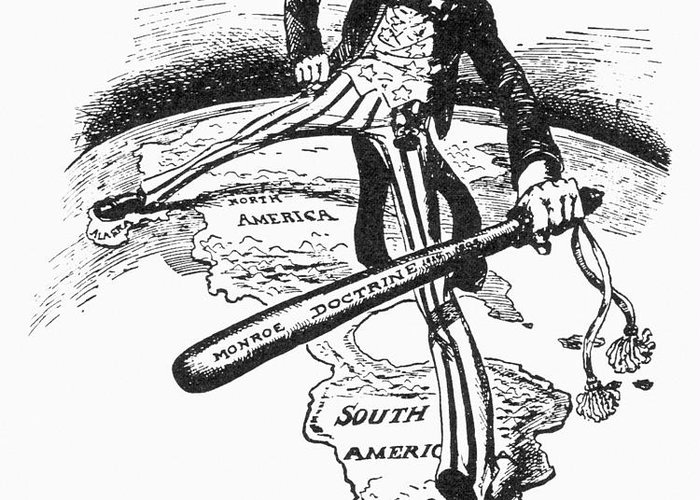
In this sense, the interventionist character of the United States sustains the country’s long-standing objective of controlling the Americas as a U.S. sphere of influence, enabling it to use tools of power and force projection—even when they violate sovereignty and the self-determination of peoples—to maintain local authority and expand economic projects of interest. Throughout this process, the use of “big stick diplomacy” to ensure political alignment in the region and protect private interests under the false pretext of guaranteeing democracy and political freedom (Galeano, 1971) has led to the imposition of dictatorships and interference in domestic politics to secure U.S. national interests.
The peak of this imperialist strategy was recently expressed through the invasion of Venezuela and the kidnapping of its president, Nicolás Maduro, which sounded a new alarm across Latin America about the risks of defending national autonomy, protecting natural resources, and refusing political alignment with the United States—under the possible penalty of suffering a similar political intervention. Thus, the projection of imperialist strategies in the region—such as threats to invade the Panama Canal to secure operational and commercial control, threats against Colombia and Mexico under the guise of combating drug trafficking, and the persistence of trade blockades and hostile policies toward Cuba—revives a long-standing regional concern: is this a new attempt to return to an era of political interventions in Latin America?
In this context, the concept of imperialism represents an important theoretical tool for analyzing state behavior within the capitalist interstate system, as the pursuit of control over economic flows and dynamics unfolds through the correlation between power, capital, and domination. These elements are employed by the United States in the region as political tools to secure and enhance its economic interests. In the case of the illegitimate invasion of Venezuela, the democratic discourse of the war on drugs and the promotion of political freedom merely serves as a disguise for the country’s real interest: oil resources and their economic potential.
The central concern for Latin America lies in the fact that there are currently no forces or institutions capable of breaking with this imperialist U.S. foreign policy, given that the configuration of the existing international order—administered under U.S. tutelage—coerces other countries into remaining inert in the face of actions that openly violate public international law. Consequently, political threats, tariffs, and U.S. economic sanctions as initial retaliation for non-alignment with its regional economic interests raise concerns about possible renewed attempts at internal interventions similar to those carried out in the past, as the scars remain open.
In light of this, the concept of hyperimperialism can also be used to highlight the current context of domination in the region, as it refers to a form of U.S. imperialism manifested through the decline and instability of its empire, which seeks to mitigate economic and political losses through the effective use of force or the threat of military operations (Cernadas; Erskog; Moreno, 2024). Thus, constant intervention—even indirectly—through sanctions, diplomatic pressure, threats of invasion, and preventive wars consolidates the country’s hyperimperialist strategy to ensure Latin America as a zone of influence under its tutelage. This represents an attempt to revive the foreign policy of the Monroe Doctrine, which sought to reaffirm U.S. political dominance in Latin America, evoking Manifest Destiny as a legitimizing narrative for imperial expansion and the expropriation and domination of peoples.
Consequently, this military operation appears to be a direct counterattack by the empire against Latin America as a whole, marking a new turning point in the region’s international relations and an attempt to implement a new cycle of interventions in local politics. In this process, discourse and the media play a crucial role in constructing narratives falsely framed as concerns for democracy and freedom, aimed at concealing geopolitical interests in controlling the country’s—and the region’s—oil reserves. In this sense, the image released shortly after the kidnapping of the Venezuelan president represents the construction of a threatening narrative toward the region, as it was posted on social media by Donald Trump as a warning about the risks of non-alignment with U.S. interests.
The persistent sense of risk of intervention and interference in domestic affairs remains latent in Latin America, where past marks and scars of foreign exploitation—and their consequences for the region’s political and economic structures—reveal the violence inflicted upon its territory. Moreover, the imperialist strategy of Trump’s foreign policy fuels this harmful process, violating fundamental principles of international relations such as national sovereignty and the self-determination of peoples, while reproducing a threatening tone toward potential interventions throughout the region as a means of protecting U.S. economic and geopolitical interests. Thus, a long-standing historical question persists across this geographic space: how can the mechanisms of imperialist domination imposed by this empire be broken?
References
CERNADAS, Gisela; ERSKOG, Mikaela Nhondo; MORENO, Tica; VENEZIALE, Deborah.(Coord.) Hiperimperialismo: un novo estágio decadente perigoso. Tricontinental Institute for Social Research, 2024.
GALEANO, Eduardo. As veias abertas da América Latina. L&PM Editores, 2010.
MARTINS, Por Antonio. Venezuela: o império ameaça e está nu. 2026. Elaborado por Boi Tempo. Disponível em: https://www.brasildefato.com.br/colunista/ricardo-pazello/2026/01/16/sinais-do-imperio-a-agressao-a-venezuela-e-o-problema-do-imperialismo-na-america-latina/. Acesso em: 16 jan. 2026.
SALGADO, Tiago Santos. O sequestro de Maduro e a permanência do imperialismo na América Latina. 2026. Elabroado por Le Monde Diplomatique Brasil. Disponível em: https://diplomatique.org.br/o-sequestro-de-maduro-e-a-permanencia-do-imperialismo-na-america-latina/. Acesso em: 16 jan. 2026.