Black Gold, New Blood: The Re-edition of Colonialism in the 21st Century
By Dimitri Cavalcanti 15/01/2026 6 min
Fascism and Neocolonialism Televised in Real Time
Unbelievably, the year 2026 began with a severe blow to Latin America, which has for so long been coveted by different nations. These same nations impose large foreign direct investments and inject money into our soil to, ultimately, generate a remittance of profit stemming from the extraction of resources and corporate success. Nevertheless, something that today can be seen as “imaginary” allowed this dynamic to be carried out within benchmarks that were once solid. Today, they are melting and being trampled by corporate, capitalist, and fascist greed. The dynamic in question was international trade, which, for extensive and complex reasons, is asymmetrical and ensures the maintenance of the status quo of power levels among nations that compose the pantheon of the powerful, to the detriment of the exploitation of natural resources and the perpetuation of inequality in less developed countries. It is worth noting that, in the post-Cold War period, this dynamic allowed, to a certain extent, international stability. International Law, nowadays, assumes an “imaginary” role, as if it did not exist—creating the ground for barbarism to germinate. What was once worshipped and seen as necessary for world peace after World War II (1939–1945) today seems obsolete. The creation of the UN after the aforementioned period, therefore, symbolizes the triumph of International Law, or at least, the guarantee that countries would not be attacked arbitrarily, bringing greater transparency to the expectations of different nations.
However, today’s world is not the same as it was in 1945. Multilateralism and international institutions, which are tools used by countries to fulfill expectations and attempt to promote peace, are no longer credited as the path toward a more prosperous and stable world by the current American president. The foreign policy stance of the United States of America (USA) reflects exactly this: President Donald Trump spares no effort to attack such institutions and led his country to withdraw from 66 international organizations, according to official government sources. His contempt for multilateral agendas and international institutions is visible, leading us to believe that US foreign policy will be based on pragmatism and the tireless pursuit of fulfilling its national interests, even if these diverge from what International Law and International Institutions preach. It is no coincidence that Trump authorized a massive operation for the capture and seizure of the former Venezuelan president, Nicolás Maduro, in order to take possession of his South American neighbor’s oil. In this sense, this type of action violates the benchmarks of International Law and even the US Constitution itself, which matters little to the chief executive, given that his geopolitical objectives—in his logic—stand above these pacts between nations and societies.
The most shocking part of all this is that it is 2026, and we can blatantly see the echoes of colonization and imperialism perpetuating and taking shape. According to outlets like The Guardian, Trump has already declared that Venezuelan oil will be controlled by Americans, which is a disrespect to the sovereignty of the neighboring country and the Venezuelan people. A good way to understand what is occurring is to look at history and the experiences of other countries. Therefore, making a parallel, Brazil went through an analogous situation once before in its history as an independent nation. In his text, Amado Cervo—a prominent scholar of Brazilian foreign policy—writes:
Europeans imposed upon the periphery of capitalism—Latin America, the Ottoman Empire, and the Asian continent at first, and black Africa at the end of the century—the way of doing trade, organizing production, and even creating political and social institutions. Bilateral treaties were then the instrument of this legal, political, and economic order. (CERVO, 2003, p. 9)
Bilateral treaties were even considered “unequal,” characterizing their nature. Brazil, to give an idea, signed several commercial treaties with England—at the time, the most powerful nation in the world—and through them, the European nation managed to virtually control our market. The Treaty of Friendship, Navigation, and Commerce (1827) guaranteed a renewal of preferential tariffs of 15% for another 15 years. This treaty was heavily criticized by the Brazilian elite for preventing the development of national industries and generating budget deficits. Despite consenting, as the treaties were indeed signed, Brazil came out penalized by the exploitation of its economy by the British, perpetuating a massive asymmetry in economic power. An experience like this shows that when Nation A is more powerful than Nation B, it will employ instruments that allow, directly or indirectly, for the increase of relative power gains. The logic of Realism, within this perspective, is fostered. Consequently, countries will tirelessly seek the perpetuation of their power and advantages over others so that their dominance can be crystallized and expanded.
The United States, as one of the world’s most powerful nations, views China and Russia as powers that challenge its hegemony and, under Trump’s command, employs any means necessary to safeguard this aspect. They invaded Venezuela and kidnapped the president, in addition to showing interest in repeating the feat with Colombia and Greenland. Furthermore, they impose exorbitant arbitrary tariffs on those who diverge from their interests (contradicting free trade) and, in doing so, penalize and weaken the economies of other countries. Bargaining and cooperation, therefore, are set aside as instruments that can promote mutual gains for the parties involved in a negotiation.
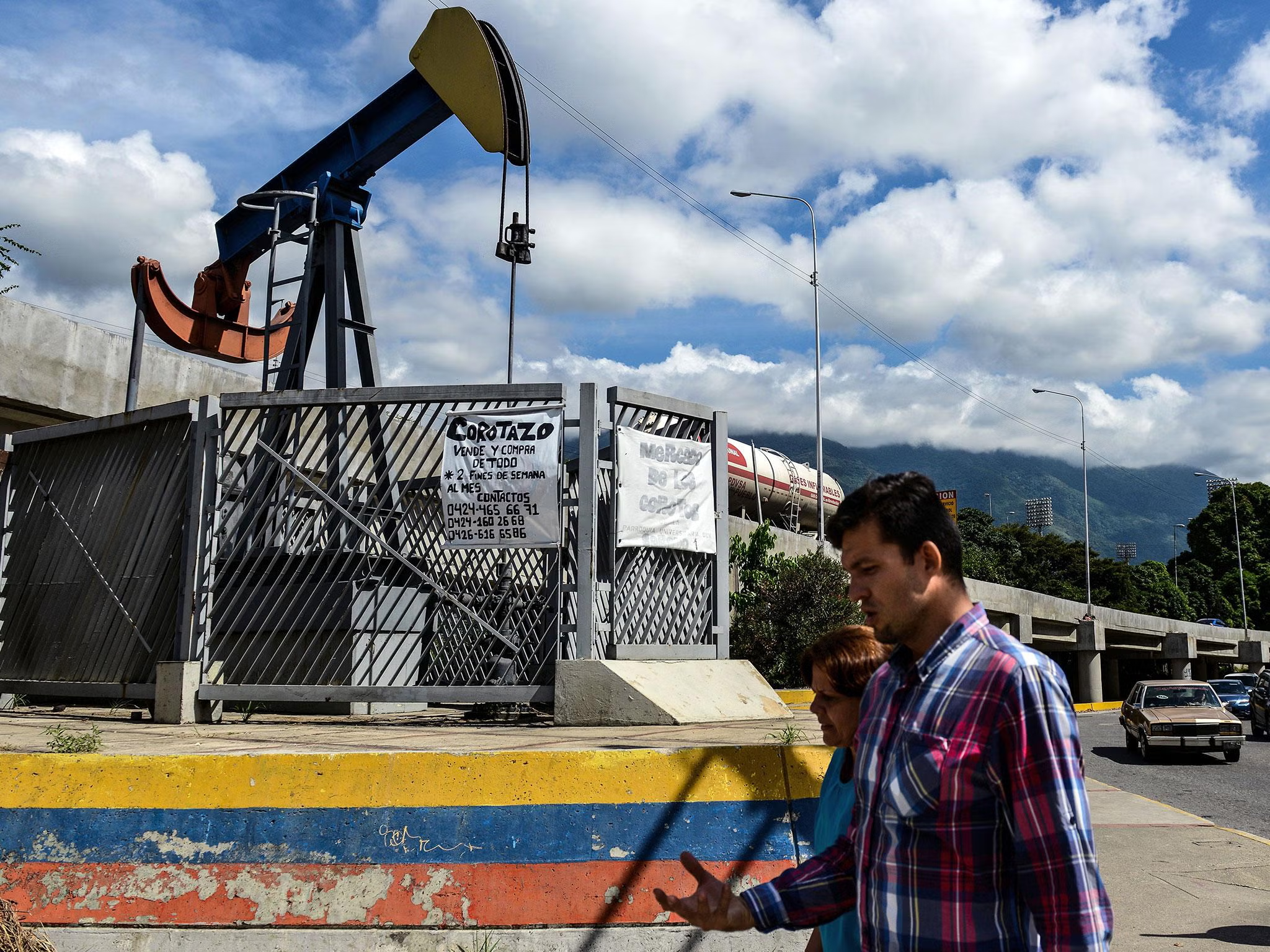
Thus, Venezuela finds itself in a very delicate situation, having become a hostage to the will and interests of the United States. One cannot say for sure what the future holds for the Latin American nation; however, just as colonizing nations did in the past to the Global South, the United States is likely to exploit the natural resources of others for its own benefit. Under a false pretext to invade the nation with the largest amount of oil in the world, Trump seized the “black gold” reserves and has already declared that he will hold the tutelage of this commodity for an indefinite period. Moreover, according to a report by CNBC, the US president stated that Venezuela will only buy American products with the revenue from the oil. I pose a question to the reader: does this type of political conduct remotely resemble the attitude Portugal once had toward Brazil during the Colonial Pact? Furthermore, if today it was with Venezuela, what are the guarantees that the same (or similar) will not happen to other Latin American nations over time? The virtual control that Trump’s greed imposes on Venezuela demonstrates that neocolonialism is more alive than ever and that current times call for reflection on the future that we, citizens of the world, want for nations. For where barbarism germinates, it is impossible for peace to prosper.
References
- CARROLL, Rory; ROGERO, Tiago. Venezuela cooperating fully and US will control its oil for years, Trump claims: US president says Delcy Rodríguez’s interim administration is doing ‘everything that we feel is necessary’. The Guardian, Jan. 8, 2026.
- CERVO, Amado Luiz. Brazilian foreign policy and international relations: a paradigmatic approach. Revista Brasileira de Política Internacional, Brasília, v. 46, n. 2, p. 5-25, Dec. 2003.
- CONKLIN, Audrey. Trump announces major oil deal with Venezuela: ‘We’re going to be buying a lot of American products’. CNBC, Jan. 7, 2026.
- UNITED STATES. Department of State. Withdrawal from Wasteful, Ineffective, or Harmful International Organizations: press statement. Washington, DC: Office of the Spokesperson, Jan. 7, 2026.