Operation Absolute Resolve and the internal US conflict
By Débora Guedes 19/01/2026 13 min
In the early hours of January 3, 2026, the world watched with growing apprehension as Venezuelan President Nicolás Maduro and his wife, Cilia Flores, were captured. The operation was carried out by the United States Special Forces’ First Operational Detachment, Delta Force, under the orders of President Donald Trump. Maduro and Flores were taken by helicopter to the USS Iwo Jima, with their final destination being a detention center in Brooklyn, New York, where they are being held and await trial. This event, which can be considered the first major international political event of 2026, makes us reflect on future scenarios marked by echoes of the past.
Amid speeches evoking the return of imperialism and alarmism surrounding a new Cold War—or even the outbreak of a new world conflict—there is a need for cautious analysis. Although human history is marked by recurring cycles of peace and conflict, in which patterns of cooperation, alliance formation, and rivalry tend to repeat themselves, albeit in different contexts, we cannot rush to treat such historical moments as rigid models for the actions of the actors that make up the contemporary international system.
The logic of dividing the world into spheres of influence, characteristic of the Cold War, remains a useful analytical tool for understanding how the major powers perceive their respective positions on different geopolitical chessboards. However, as the global scenario changes, the players and pieces that make up this political game also change. New actors have gained centrality while others take on a more secondary role. We have the classification made by the United States in 2018, during Donald Trump’s first term, which elevates the position of China and Russia to the level of rivals or strategic competitors, but with a readjustment of forces that leans toward China, which assumes the position of the main threat to the interests of the liberal world order led by the United States—a leadership that, in turn, is increasingly contested. is increasingly contested. In addition, factors such as the increase in the number of states possessing nuclear weapons, coupled with the rapid advancement of military technologies and their impact on the battlefield, significantly alter the strategic calculation, raising the political and military costs associated with the use of force.
However, the common element in the aforementioned expressions lies in the fact that they refer to historical periods in which international politics was structured around the logic of power struggles between great powers. In this sense, it is essential to highlight that this competition does not manifest itself in a homogeneous way or restricted to a single plane, but occurs simultaneously at different levels—international, continental, or regional, and in certain cases, also at the domestic level—and crosses different dimensions of national power, such as political, military, and economic, among others.
In light of this perspective, the episode of US military intervention in Venezuela, aimed at capturing President Maduro, must be understood from the multiple layers of this conflict. This article inaugurates a series of analyses that aim to evaluate the conflict between the United States and Venezuela from different levels of analysis. This text focuses on Operation Absolute Resolution of January 3 and its political ramifications, and how the operation can be considered not only a direct reflection of the internal disputes that permeate the domestic political scene in the United States, but also contributes to intensifying them.
Operation Absolute Resolve and the internal dispute for the final say in the decision-making process
The so-called “Operation Absolute Resolution,” a name given by the U.S. War Department—formerly the Department of Defense—was characterized by its swift and efficient execution. It is estimated that the operation lasted approximately five hours in total, culminating in the capture of President Maduro and his wife in an exceptionally short time, less than a minute.
The escalation of military tensions between Caracas and Washington has already been the subject of previous Dpolitik columns. Among them, I highlight the text entitled “From rapprochement to rupture: the diplomatic crisis between Washington and Caracas,” which presents a timeline of events that culminated in the first phase of the American offensive in the Caribbean. This initial stage of the operation, analyzed in greater depth in the aforementioned text but which can be summarized as a period marked by the mobilization and use of the US military apparatus in naval interdiction operations, with the shooting down of vessels allegedly carrying illegal drugs and crewed by members of the Venezuelan organized crime group Tren de Aragua — classified by the United States as a terrorist organization in January 2025 — in international waters near the Venezuelan coast.
These operations, conducted between September and October 2025, were followed by an intensification of coercive measures by Washington. In November, the US government announced the closure of its airspace, and in December, President Trump ordered a “total and complete” blockade of all sanctioned oil tankers entering or leaving the Venezuelan coast. This aerial and naval blockade, combined with tactics to monitor the routine of the then Venezuelan president and his wife, were the central elements in the rapid execution of the operation to capture Maduro, who was accused by the US Court of Justice of four different types of crimes, the main charge being that he was a narco-terrorist and leader of the “Cartel de los Soles,” a narco-terrorist organization allegedly composed of high-ranking members of the Venezuelan government.
In a statement to the press, Donald Trump declared that the operation in question had been planned for months. However, neither the planning process nor the final decision were submitted to the U.S. Congress for approval, raising questions about the legality of the action under the U.S. Constitution. The Constitution states that military interventions in foreign territory must be authorized in advance by Congress.
Faced with accusations of illegality raised by the Democratic opposition, Trump responded forcefully, claiming that “Congress was not trustworthy” to handle an operation of this nature. At the same time, Secretary of Defense Marco Rubio stated that the operation was not a military invasion, but rather a law enforcement operation, and that the United States was not at war with Venezuela, but rather with drug trafficking. Rubio added that Delta Force members remained on Venezuelan soil for approximately two hours, which was strictly necessary to capture Maduro and neutralize any threats to U.S. agents.
In a statement to the press, Donald Trump declared that the operation in question had been planned for months. However, neither the planning process nor the final decision were submitted to the U.S. Congress for approval, raising questions about the legality of the action under the U.S. Constitution. The Constitution states that military interventions in foreign territory must be authorized in advance by Congress.
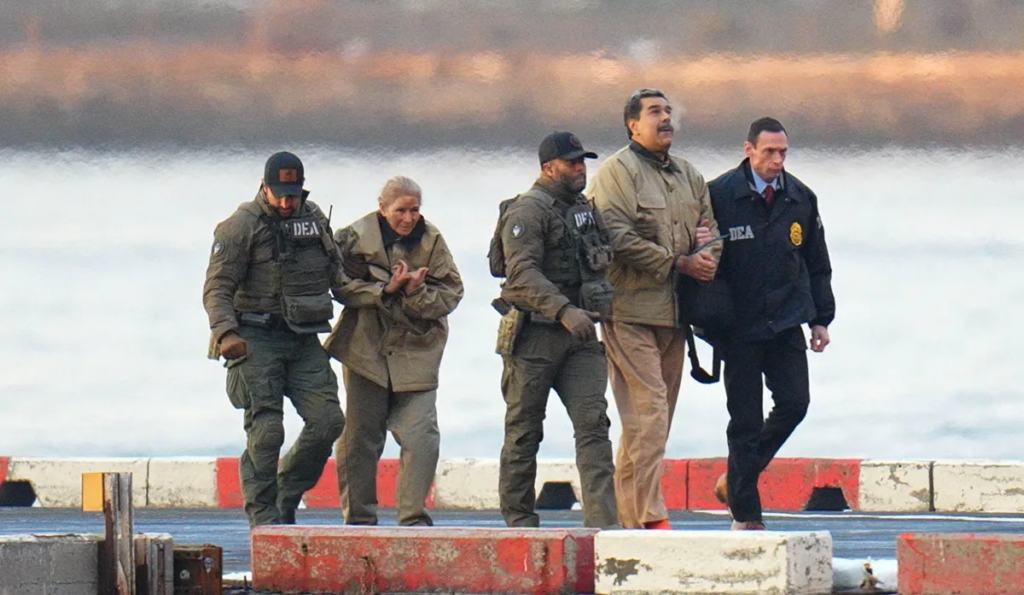
Nicolás Maduro and his wife, Cilia Flores, are seen in handcuffs after landing at a helipad in Manhattan, escorted by armed federal agents (Photo: CNN Brasil)
In contrast to this narrative, Venezuela’s Interior Minister, Diosdado Cabello, stated that the military action conducted by the United States on January 3 resulted in approximately 100 casualties, including civilians, in addition to striking multiple locations in the capital, Caracas. It is worth noting that Cabello—who is responsible for commanding Venezuelan security forces—has been accused by the US justice system of involvement in drug trafficking since 2015, in addition to accusations of systematic human rights violations. According to speculation in the international media, Cabello is being pressured by US authorities not to obstruct channels of dialogue and cooperation between representatives of the Trump administration and Venezuelan Vice President Delcy Rodríguez, with whom he has a history of rivalry within the upper echelons of the Maduro government. Such pressure is said to be associated with the implicit threat that Cabello could become the next target in a possible offensive by Washington against Caracas.
Review of the first year of Trump’s second term: conflicts of interest, political deadlocks, and growing popular dissatisfaction
Operation Absolute Resolve is further fueling an increasingly heated domestic political scene in the United States. In Trump’s first year in office, the dispute between the executive branch and Congress was marked by episodes of conflict, resulting in the longest government shutdown in U.S. history. Due to the impasse in approving the budget, which was the result of protests by the Democratic opposition against severe cuts in priority areas such as health care that occurred throughout the year, the government was paralyzed for 43 days, when an agreement was finally reached.
At the same time, public dissatisfaction grew with the actions of Immigration and Customs Enforcement (ICE), the agency within the Department of Homeland Security responsible for enforcing the new administration’s immigration policy. Criticism intensified in the face of reports of arrests of foreigners in regular status and, in some cases, American citizens, often without a valid warrant. This confrontation reached a new level after the January 7 incident, when U.S. citizen Renee Nicole Good was shot and killed by an ICE agent while protesting a law enforcement operation in her neighborhood in Minneapolis, Minnesota. The incident sparked a series of protests in the city and elsewhere in the country and imposed serious differences between the views of federal and local authorities on the use of force by ICE agents.
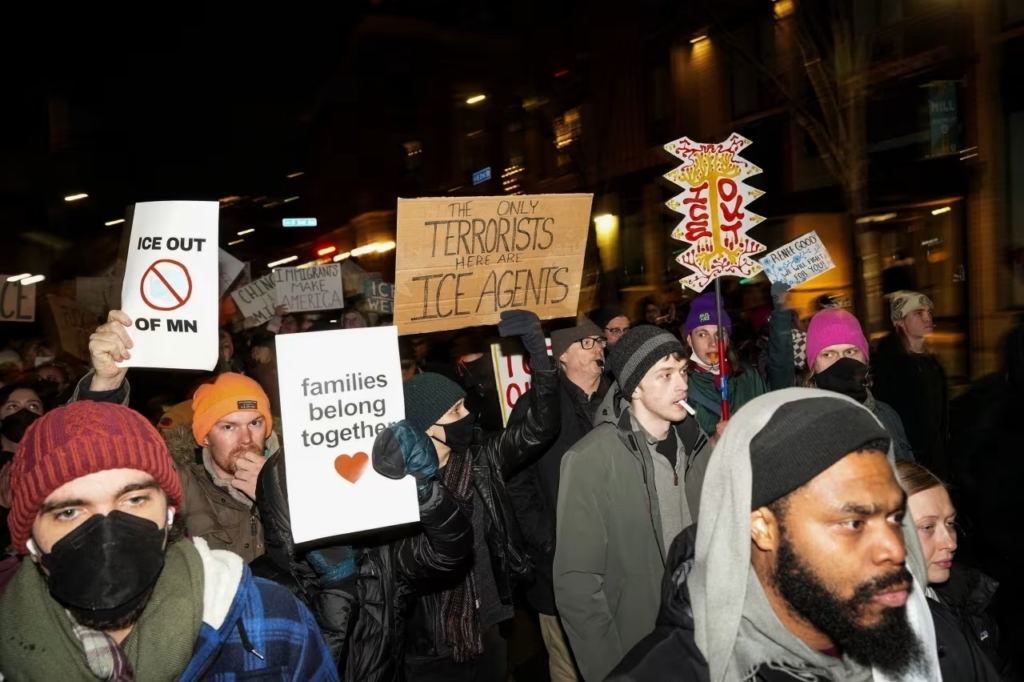
People march during a demonstration against increased immigration enforcement, days after the killing of Renee Nicole Good by an Immigration and Customs Enforcement (ICE) agent in Minneapolis, Minnesota (Photo: CNN Brasil)
In a dispute over narratives, federal authorities claimed that the agent had acted in self-defense. This case gained widespread attention and intensified debates about the role of ICE and the Trump administration’s immigration policy. This dispute over narratives has been one of the main tools used by federal authorities to frame the government’s actions in a way that always favors the interests of the White House. Some international policy analysts, such as Professor Oliver Stuenkel in an interview with the podcast “O Assunto” on the G1 news portal, see the Trump administration’s attack on the Maduro regime as a way to appease internal conflicts and popular dissatisfaction, uniting the population against a common enemy. This is a very common rhetorical strategy often used by American leaders in times of crisis.
Furthermore, the justification for Maduro’s capture was not only based on allegations of criminal association, corruption, and abuse of power, but also as a measure to curb the migration crisis generated by the Venezuelan crisis, which has been ongoing since 2014 but reached its peak between 2018 and 2019. Elected by the American people not once, but twice, with a strong anti-immigration platform, and after a failed attempt to build a wall on the Mexican border during his first term, Trump took an even more assertive stance in his second term, authorizing mass deportation operations, with immigrants of Latin American origin or descent as the main targets.
However, following the publication of the National Security Strategy, a document that lists the foreign policy priorities of each presidential administration, the Trump administration has framed relations with Latin America and the Caribbean within the logic of reviving the Monroe Doctrine. The Monroe Doctrine has been the main organizing principle of relations between the United States and Latin America since the 19th century, when it was first conceived. Although the Doctrine has undergone changes over time, it establishes that no power other than the United States has the authority to interfere in what has come to be established as the US’s natural sphere of influence. From that moment on, the national security of the United States became directly linked to the security and maintenance of American interests in the region. This discourse was taken up again by Trump and Rubio during the press conference after the operation in Venezuela. They reiterate that the Western Hemisphere “belongs” to the US and that no action by regional adversaries, as well as the actions of extra-regional rivals and competitors, would be tolerated.
However, following the publication of the National Security Strategy, a document that lists the foreign policy priorities of each presidential administration, the Trump administration has framed relations with Latin America and the Caribbean within the logic of reviving the Monroe Doctrine. The Monroe Doctrine has been the main organizing principle of relations between the United States and Latin America since the 19th century, when it was first conceived. Although the Doctrine has undergone changes over time, it establishes that no power other than the United States has the power to interfere in what has come to be established as the natural sphere of influence of the US. From that moment on, the national security of the United States became directly linked to the security and maintenance of American interests in the region. This discourse was taken up again by Trump and Rubio during the press conference after the operation in Venezuela. They reiterate that the Western Hemisphere “belongs” to the US and that no action by regional adversaries, as well as the actions of extra-regional rivals and competitors, would be tolerated.
For Trump’s administration, the US acted within its rights, according to principles such as Manifest Destiny, a principle that dates back to the period of independence, when the “founding fathers” established that it was the responsibility of the United States to maintain and advance democracy in the world. Although such American attitudes have been met with strong opposition from countries inside and outside Latin America, which reiterate that the sovereignty and physical integrity of countries must be respected, and the statement by the Office of the United Nations High Commissioner for Human Rights (UN) classifying American action in Venezuela as a serious violation of international law, Trump threatens not to stop at Venezuela. Countries such as Cuba and Colombia are pointed out by the American president as possible future targets of operations by the United States. These countries have their own political and security vulnerabilities, but they share in common the fact that they have leaders who are critical of President Trump, which, as mentioned in one of his statements above, is an attitude that will not be tolerated.
References:
Ataque dos EUA na Venezuela deixou 100 mortos, incluindo civis, diz governo. Portal G1, 07 de jan. 2026. Disponível em: https://g1.globo.com/mundo/noticia/2026/01/07/ataque-eua-mortos-civis-venezuela.ghtml.
AYERBE, Luis F. Estados Unidos e América Latina: a construção da hegemonia. São Paulo: Editora UNESP, 2002.
BANDEIRA, Luiz A. M. A Segunda Guerra Fria: geopolítica e dimensão estratégica dos Estados Unidos. Rio de Janeiro: Editora Civilização Brasileira, 2018.
BESTRAND, Natasha. COHEN, Zachary; HANSLER, Jennifer. Maduro e esposa bateram a cabeça na captura, diz governo Trump ao Congresso. CNN Brasil, 06 de jan. de 2026. Disponível em: https://www.cnnbrasil.com.br/internacional/maduro-e-esposa-bateram-a-cabeca-na-captura-diz-governo-trump-ao-congresso/.
BRAUN, Julia. Como foi a deposição de Maduro: a linha do tempo do ataque de Trump à Venezuela. BBC Brasil, 05 de jan. de 2026. Disponível em: https://www.bbc.com/portuguese/articles/ce8gezn9p3vo.
Entenda as acusações que Nicolás Maduro enfrenta nas Estados Unidos. CNN Brasil, 04 de jan, de 2026. Disponível em: https://www.cnnbrasil.com.br/internacional/entenda-as-acusacoes-que-nicolas-maduro-enfrenta-nos-estados-unidos/
Fim do Shutdown: Trump sanciona orçamento nos EUA. Portal G1, 12 de nov. de 2025. Disponível em: https://g1.globo.com/mundo/noticia/2025/11/12/shutdown-camara-eua-projeto-trump.ghtml.
Law Enforcement Operations. Site Gif Consulting, 29 de mai. de 2025. Disponível em: https://gifconsulting.com/blog/law-enforcement-operations/.
MUSA, Amanda. Saiba quem era a mulher morta a tiros por agente de imigração dos EUA. CNN Brasil, 08 de jan. 2026. Disponível em: https://www.cnnbrasil.com.br/internacional/saiba-quem-era-a-mulher-morta-a-tiros-por-agente-de-imigracao-nos-eua/.
O ASSUNTO: Venezuela invadida por Trump e a deposição de Maduro. Entrevistados: Leonardo Trevisan; Oliver Stuenkel. Entrevistadores: Natuza Nery. G1: 03 de jan. de 2026. Podcast. Disponível em: https://open.spotify.com/episode/7ic2CfzuA47m8OPVbdQKcq?si=a132baab97a64163.
O que é a Força Delta, tropa de elite dos EUA que capturou Maduro. Portal G1, 03 de jan. de 2026. Disponível em: https://g1.globo.com/mundo/noticia/2026/01/03/o-que-e-a-forca-delta-tropa-de-elite-dos-eua-que-capturou-maduro.ghtml
PARK, Hanna. Autoridades declaram protestos contra ICE em Minneapolis como ato “ilegal”. CNN Brasil, 10 de jan. de 2026. Disponível em: https://www.cnnbrasil.com.br/internacional/autoridades-declaram-protestos-contra-ice-em-minneapolis-como-ato-ilegal/.
Por que Trump não pediu autorização do Congresso americano para atacar a Venezuela? Portal G1, 05 de jan. 2026. Disponível em: https://g1.globo.com/fantastico/noticia/2026/01/05/por-que-trump-nao-pediu-autorizacao-do-congresso-americano-para-atacar-a-venezuela.ghtml
RUBIO, Marco. This Is Our Hemisphere — and President Trump Will Not Allow Our Security to be Threatened. Site da Casa Branca, 4 de jan de 2026. Disponível em: https://www.whitehouse.gov/articles/2026/01/rubio-this-is-our-hemisphere-and-president-trump-will-not-allow-our-security-to-be-threatened/.
SACHEZ, Ray; ROMO, Rafael. O que é o Tren de Aragua, a guangue venezuelana alvo do ataque dos EUA. CNN Brasil, 02 de set. de 2025. Disponível em: https://www.cnnbrasil.com.br/internacional/o-que-e-o-tren-de-aragua-a-gangue-venezuelana-alvo-do-ataque-dos-eua/
SILVA, Junio. Senado dos EUA aprova medida que freia ações de Trump na Venezuela. Site Metrópoles, 08 de jan de 2026. https://www.metropoles.com/mundo/senado-dos-eua-aprova-medida-que-freia-acoes-de-trump-na-venezuela.
SOCHAN, Sakkel; HUBENKO, Dmytro; OELOFSE, Louis; MAJUMDAR, Roshni; JONES, Timothy. Trump warns Venezuela’s interim leader to “do what’s right”. Deutsche Welle, 05 de jan, de 2026. Disponível em: https://www.dw.com/en/whats-next-in-venezuela-after-maduro-taken-to-us/live-75382023. Trump Approval Tracker. Site do The Economist, 10 de jan. de 2026. Disponível em: https://www.economist.com/interactive/trump-approval-tracker.