U.S. foreign policy: a path with no clear destination
By Maria Mont' Serrat Bomfim Mariano dos Santos 03/04/2026 14 min
Foreign Policy is, pardon the punchline, a foreign concept for many. Although it may appear with some regularity on the news, most people are more concerned with domestic policies given that they seem to have a greater impact on the aspects of a daily life. Moreover, concepts of international politics may seem difficult to grasp for most people outside of this field of study. However, Foreign Policy, as any policy, can affect greatly even the most common affairs of the life of a citizen. Even the Foreign Policy of another country can have great impacts. Given that, the aim of this text is to help bring some light into the concept in hope of achieving some degree of understanding of the many foreign policy decisions we are seeing right now. Moreover, to help understand a bit of the almost 250 years of the US Foreign Policy, considering that the decisions of a single leader can greatly impact the international arena.
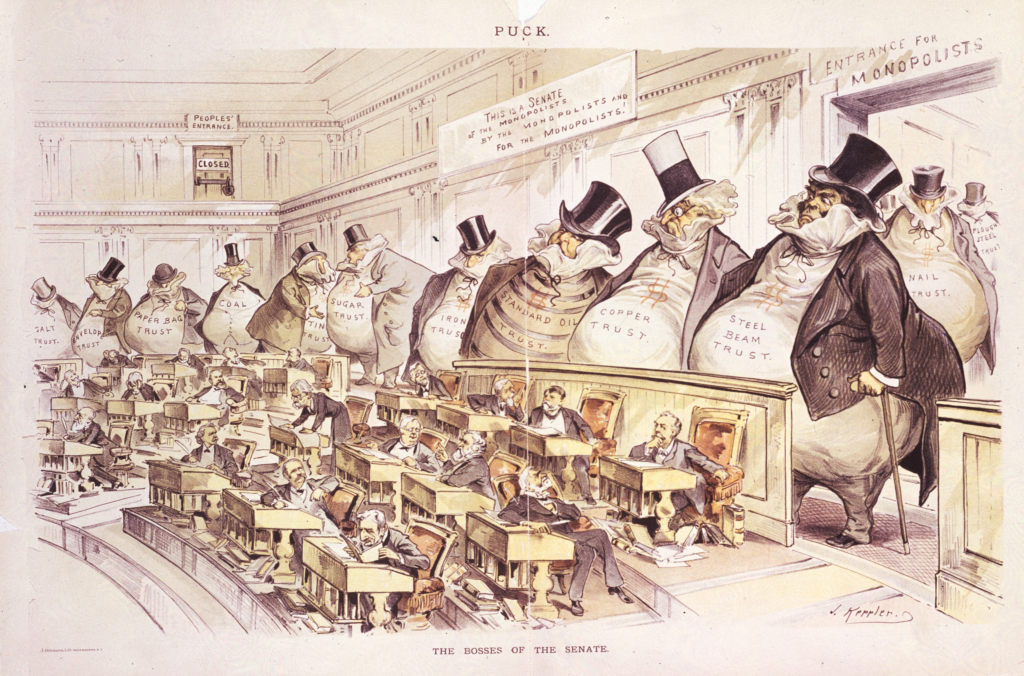
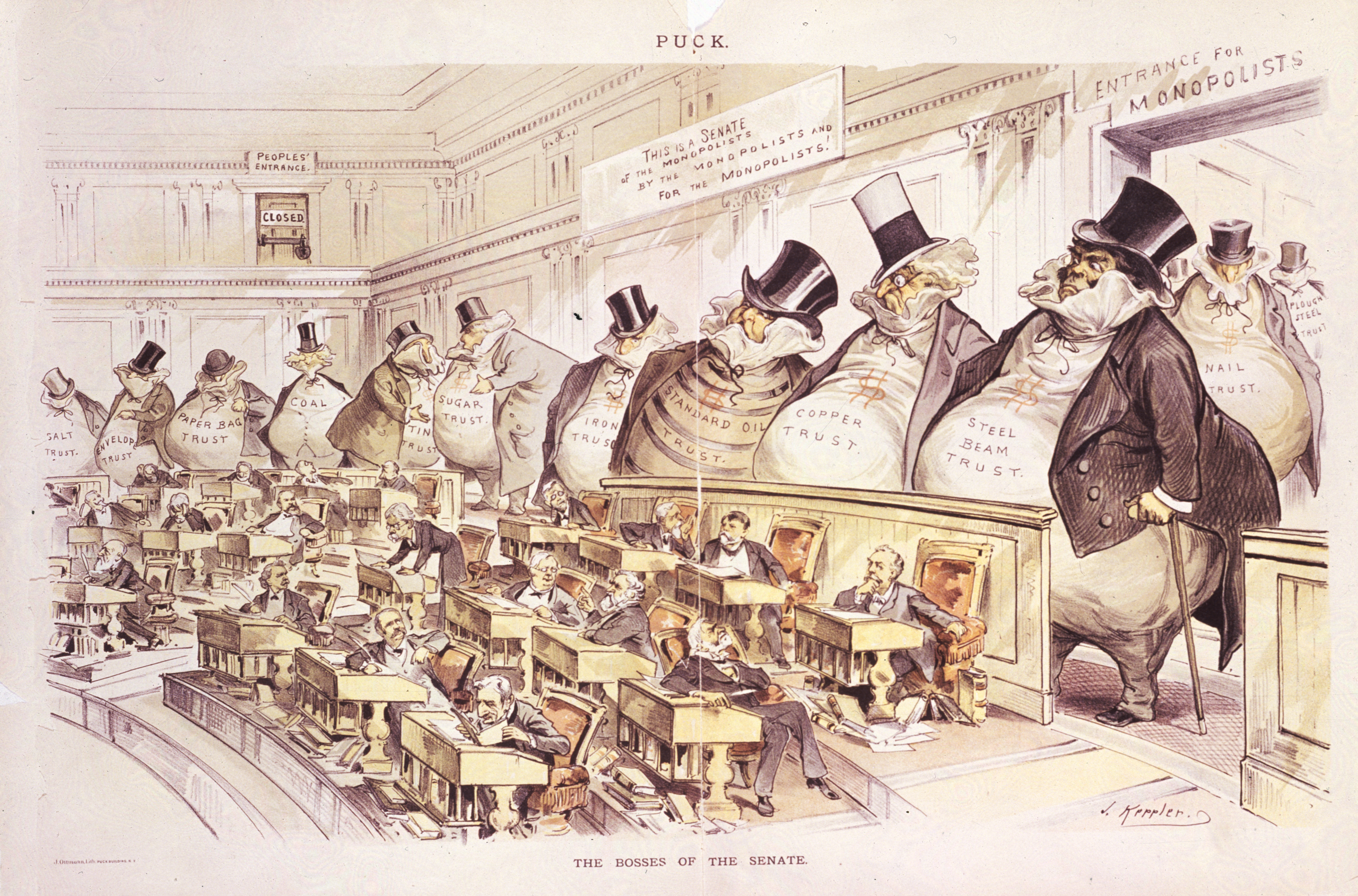
A famous cartoon by Joseph Keppler, 1889, depicting the role of corporate interests in Congress. Source: Wikipedia.
What’s Foreign Policy?
Valerie Hudson brings forth the following definition to Foreign Policy: “The strategy or approach chosen by the national government to achieve its goals in its relations with external entities, which includes decisions to do nothing”. Therefore, in her book with the same title, Hudson describes Foreign Policy Analysis (FPA) as “The subfield of international relations that seeks to explain foreign policy, or alternatively, foreign policy behavior, with reference to the theoretical ground of human decision-makers, acting singly and in groups”. Presenting this definition is important in order to make the challenges of this field more understandable. When talking about Foreign Policy Analysis, it is necessary to face the endeavor of understanding human behavior.
Unlike most fields of International Politics, Foreign Policy Analysis (FPA) focuses on decision-makers, that is, human agents. FPA cannot be state-oriented, because states are not agents – they are abstractions, and thus have no agency. Only humans can be true agents (Hudson, 2016, p. 7). This means that FPA is agent-oriented rather than state-oriented and also actor-specific because it analyzes the decisions that one individual or a group of individuals made or could make in a given situation. It believes as well that all changes in international politics are a result of this agency. In other words, people are the ones who make decisions – either to start a war or not; to make a trade deal or not; to sign a treaty or not and so on and so forth. Furthermore, it is very important to highlight that to do nothing is also an FPA decision. Rather, it is important to understand that the decision not to do something can be just as consequential as the decision to do something.
A classical example would be the response from the prime minister of the United Kingdom, Neville Chamberlain, during the lead-up to World War II. In the face of Adolf Hitler’s territorial expansion—particularly the remilitarization of the Rhineland in 1936 and later actions—Britain chose not to intervene militarily. This restraint, often associated with the broader policy of appeasement, can be understood in FPA terms as a conscious decision not to act. The choice to refrain from confrontation was not an absence of policy, but rather a deliberate foreign policy decision shaped by a specific leaders’ perceptions, calculations, and preferences.
Therefore, FPA gives an important contribution to understanding how culture, national identity, the background of leaders, its beliefs, political myths, as well as other factors, can influence a state’s behavior. Since humans are the ones making the decisions, prejudices, biases, and personal beliefs, for instance, should be taken into account. In other cases, the political regime of a country, its history, and tradition can matter more than the leader’s personal creed, for example. But in any case, humans are the point of theoretical intersection between the most important determinants of state behavior: material and ideational factors (Hudson, 2016, p. 8).
Hence, as any other country, the US Foreign Policy is affected by its culture. Also, its history, and the political myths that helped to forge its national identity contribute daily to the perceptions of its leaders. The decisions that American presidents take in foreign affairs are partly forged by how these leaders perceive what the US is and what role it has in the world. This is why documents, such as the National Security Strategy matter. In its words, it’s possible to observe what are the perception of the current administration on matters of Foreign Policy. In the last version of this document, the NSS 2025, it’s possible to see the influence of a blend of schools of thought on international relations and foreign policy.
In the midst of this blend, Realism stands out. In short, this is the view that power should be the primary concern of states in international relations—and the United States wishes to remain “the most powerful.” It is well established that the international system is one of anarchic nature, which means that there is no power in it strong enough to subdue all the others or to apply rules and ensure compliance. There is no superstate, therefore, one must assume that states will consider themselves first in a self-help system. Furthermore, one can see Trump’s admiration for the Monroe Doctrine, which, in the 19th century, rejected the influence of external actors on the American continent. From this perspective, one can observe the U.S. interest in targeting a strategic competitor—China—through the capture of Maduro. Due to the fact that most of Venezuela’s oil—80% of the country’s total production—is sold to China.
Thus, the U.S. action seeks, in one fell swoop, to strike at China by reducing its presence in Latin America, a region still viewed as a U.S. sphere of influence; as well as to remove Maduro, a dictator whose government has not been recognized by the U.S. for many years. The failure to recognize Maduro as the legitimate leader of Venezuela, by both Trump and the previous administration, Biden, served as justification—at least domestically—to legitimize the U.S. action, which was defined by the Trump administration as an operation to enforce an arrest warrant against the Venezuelan president, not an act of war or foreign intervention. The swift action, followed by the agreement with Delcy Rodríguez, Maduro’s vice-president, secured a victory for the US. Not only Maduro’s regime fell, but also did the Cuban oil supply. Now, Cuba faces its biggest crisis since the dissolution of the Soviet Union and the US is eager to see another unpalatable regime in Latin America fall.
The US Foreign Policy
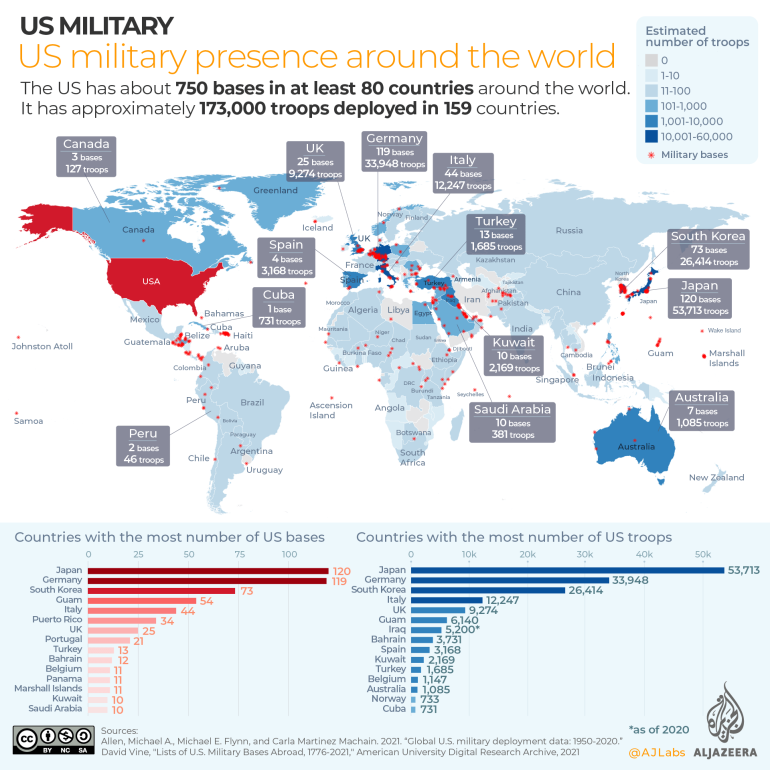
As any other country, the US has a tradition of Foreign Policy. Although this tradition has experienced change through time, the United States has considered the American continent its sphere of influence since the early nineteenth century. However, it could be argued that the US now – after the Cold War – considers the whole world its sphere of influence considering the massive military presence the country has around the globe. Much of this military presence comes from the legacy of the Second World War and the Cold War, as it can be observed below. Germany and Japan, after being defeated in the war, were occupied by the US. These countries occupy second and first position in countries with the most military bases and number of troops, according to the data shown below. South Korea follows in third position, mostly due to the Korean War.
However the military presence of the US in the American continent can be dated far back. In 1823, President James Monroe warned Europe’s imperial powers not to interfere in the Americas, fearing Spain and France would recolonize the region. On the following century, President Theodore Roosevelt doubled down on the Monroe Doctrine and decided to include a more muscular policy, known as the Roosevelt Corollary. From this moment on, the US would not only feel emboldened to act against European powers trying to extend their influence in the Americas, but would also directly intervene in regional countries that it saw as weak, unstable, or in any other way vulnerable to foreign influence. This led to a series of interventions from the United States throughout the region, often to advance its own interests rather than just to prevent European influence.
Despite these recent successes for the US Foreign Policy – from the country’s perspective -, History might be ruthless when the subject is foreign intervention, such it was the case in Cuba in 1961 with the Bay of Pigs Invasion. This event later led to the Cuban Missile Crisis in 62. Therefore, even though it might seem easy to understand why the US acted in this way when one considers the pursue of power as the main driver of International Relations, it’s necessary to consider other factors that might have influenced the process of decision-making. However important the knowledge of a general theory, such as Realism, may be, it does not excuse the decision maker or the analyst from the necessity of knowing the specifics, the context, and even the details of a foreign policy issue.
That is so because the universalization of a theory, without paying attention to the particularity of a situation, as well as the confusion of understanding assumptions as scope conditions or as predictions, can lead to gross errors in FPA. Only by knowing the details of a given foreign policy issue can one determine whether the circumstances under analysis truly correspond to the parameters of a given theory (Wohlforth, 2016, p. 45). Therefore, it’s imperative to understand the role of culture and national identity in matters of Foreign Policy, especially considering the grave consequences for the Middle East and the world that can be traced back to the War on Terror.
Unlike a state that has a delimited territory, terrorists don’t have defined geographical boundaries. This makes even the idea of victory much harder to assert. Not only is it harder to identify and strike targets, but also, how can one declare that a set of extremists ideals were defeated? As it was seen in the case of Afghanistan, after fighting for 20 years, Taliban remained strong and coherent, seizing the chance to take over the country. Although the US can claim to have had victory over some of its objectives, fact remais that its withdrawal was embarrassing for the leading military power in the world. Therefore, to justify being in a constant state of warfare in order to fight an elusive enemy, one must evoke strong traits of national identity, such as American Exceptionalism, that is, the idea that the US is exceptional, the ‘City upon the Hill’, a sort of promised land, the ‘New Jerusalem’. This idea is encompassed in statements such as “Leader of the free the world” in reference to the President of the United States, as if the US were the leader of other nations that share values such as freedom. In this sense, “Who are we?”, “What do we do?”, and “Who are they?” are foundational questions about identity (Hudson, 2014, p. 118).
The first question implies that there is some general conception of what it means to be an American, for example. There is some significance to this fact, such as shared values and preferences that could define American culture. The second question implies that there is an expected behavior of an American. This leads to an understanding of what an American would do in a certain foreign policy situation. Are Americans more or less prone to war? In the event of a threat, are they more likely to escalate or de-escalate the situation? When making a threat, are they more or less likely to carry it out? Again, these definitions are not guarantees or predictions, since every foreign policy situation will require a specific approach. Before the invasion of Iraq in 2003, when the USA was only threatening to do it, Saddam Hussein did not believe that they would. He thought that American action would be more restrained, and, mostly, he didn’t think of the country as a rival because of their previous history. The Iraqi leader believed that Iraq and the USA could even be allies in fighting Islamic radicalism after 9/11.
Building up on that, the third question concerns itself with the differential. That is, a Russian, it may be expected, would have a different behavior from an American, but a Russian would not see himself entirely according to the American perception of the Russian people. This differentiation is important, especially in conflict situations where an enemy or an adversary needs to be defined or when questionable behavior needs to be justified. Culture not only alleviates concern over our own identity, but it also helps alleviate concern over whom we are dealing with (Hudson, 2014, p. 119). We are seeing this right now during the war against Iran. Marco Rubio, the US Secretary of State, declared that the Persian country is run by “religious lunatics”. However in the US, religion has also been used to justify support for this war. Even though it’s not possible to affirm that religion dictates all the aspects of the US civil law, as it’s the case in Iran. Naturally, the idea of such declarations is to make it clear that the other, the enemy, the one who must be fought, is different. It’s important to do that not only to define what the country is fighting against, but also to reaffirm one’s own identity. That is, what the country is defending, as it can be noted in sentences such as “Iran hates our way of life”.
Likewise, the myth of civilization versus barbarism creates an idea of direct antagonism (us against them), us against the Nazis, us against the communists, and, more recently, us against the terrorists. After the end of the Cold War and the apparent victory of liberal democracy over tyranny, oppression, and totalitarianism, a famous book was written by Samuel Huntington in which he described that the conflicts from that point on would be led by cultural differences rather than ideological ones. ‘The clash of civilizations’, as the author described, would happen as a consequence of the irreconcilable differences among Western and Eastern societies, for example. This is, indeed, a simplified version of the argument. However, it is not difficult to grasp why a cultural reason would be more easily accepted than an economic one, for instance. If the average American has a Weltanschauung – a cosmovision – of what it means to be an American, as well as a perspective of what it means to be a Russian, a Chinese or a Persian, and, in this view, consider these world views irreconcilable, it is way easier to understand a war under these terms. Rather than questioning self political gains, interests, economics, etcetera.
Naturally, over the course of its almost 250 years, the US Foreign Policy has changed, sometimes going through a more isolationist period. Although, especially over the last decades, the US Foreign Policy has been one of wars and interventions. Mostly, these military actions were justified under the flag of fighting terrorism. Also, culturally, it could be argued that Americans understand the use of force as a legitimate way of pursuing its goals in International Politics.
Conclusion (for now)
After the 9/11 attacks, President George W. Bush declared ‘war on terror’. For the first time, the US committed itself to fight an evil not so easy to define and grasp. Terrorism may be based in one or more states, but it is not one. Therefore, the same kind of behavior cannot be expected, as well as the rules applied to this kind of conflict (known as irregular), are not the same. Often, terrorist groups rely on a certain level of support from the population, they seek the lingering of the conflict more than its resolution and are more interested in getting attention, and gathering supporters than in negotiating. Terrorism can also be bred domestically. It is harder to identify and fight because it is often not confined to a single area. Evidently, through the internet, it can be spread cross-borders more easily. The open-ended definition of U.S. strategic priorities in the “War on Terror” goes beyond what the United States committed itself to during the Cold War (Esch, 2010, p. 365). Therefore, it seems that this task is designed to be impossible to complete, trapping the US Foreign Policy in never ending wars.
In this sense, the trajectory of U.S. foreign policy appears less like a straight road toward a defined objective and more like a path whose destination is constantly shifting. The same impulses that shape American action—power politics, identity narratives, historical myths, and the perceptions of individual decision-makers—also create competing priorities. Should the United States focus on reaffirming its traditional sphere of influence in Latin America and containing China’s growing presence there? Or should it continue to devote strategic attention and military resources to the Middle East, where conflicts have historically drawn the country into prolonged interventions? Each direction reflects a different understanding of threats, interests, and identity. Yet neither offers a clear endpoint. As the preceding discussion suggests, foreign policy decisions are rarely the product of a single coherent strategy; rather, they emerge from the interaction of leaders, beliefs, historical experiences, and immediate political pressures. For the United States, this means that the pursuit of influence—whether in Latin America, in the containment of China, or in the turbulent politics of the Middle East—often unfolds without a clearly defined final destination, reinforcing the notion that its foreign policy continues to follow a path whose ultimate direction remains uncertain.
References
ESCH, Joanne. Legitimizing the “War on Terror”: Political Myth in Official-Level Rhetoric. Political Psychology, Vol. 31, No. 3. p. 357-391. (Jun. 2010).
HUDSON, Valerie M. Foreign Policy Analysis: Classic and Contemporary Theory. Maryland:Rowman & Littlefield, 2014.
HUNTINGTON, Samuel. The clash of civilizations? Foreign Affairs, 72, 22–50, 1993.
MEARSHEIMER, John J.; WALT, Stephen M. The Israel Lobby and U.S. Foreign Policy. September 2007, Farrar, Straus and Giroux, LLC, 2007.
MEARSHEIMER, John J. The Great Delusion. Lecture. Carleton University. 30.01.2020. URL: https://youtu.be/nZVIaXFN2lU. (03/03/2022).
https://education.cfr.org/learn/reading/modern-history-and-us-foreign-policy-americas