Can Israel do anything?
Por Caio Ponce de Leon Ribeiro Freire 14/02/2024 15 min
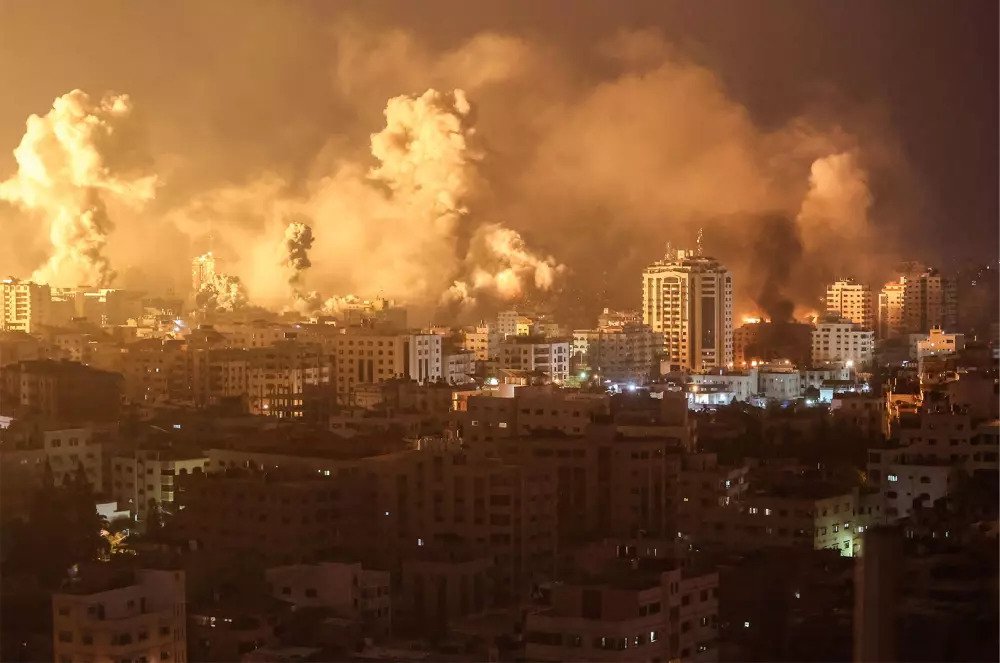
Since the attack carried out by the terrorist organisation Hamas on 7 October, Benjamin Netanyahu’s government has been responsible for atrocities committed against the population of the Gaza Strip, violating international law, flouting the UN and all with the backing of several Western countries.
“Do you condemn Hamas?” is the automatic question asked by Western media journalists to any interviewee who comes to denounce the calamities that have been inflicted on the inhabitants of the Palestinian territory of Gaza. This is almost a “civilising” version (ironically speaking) of the well-known “Turing test” that was devised to check whether a machine user is a human being or a machine. For the editorial staff of many media, including Brazilian media, this is the test needed to know whether what the interviewee will say can be considered or directly rejected as “pro-terrorist propaganda”.
Almost a month ago, Israel was vilely attacked by the terrorist group Hamas, which controls the Gaza Strip. This happened on 7 October, just after the anniversary of the start of the Yom Kippur War, which was based on a surprise attack led by Egypt, Syria and Iraq in 1973 against Israel in the middle of one of the most important religious festivals in the Jewish calendar. Twenty days and more than 18,000 dead later (2,600 on the Israeli side against between 8,000 and 15,000 on the other side), Israel emerged victorious from the war. Over the decades, Israel’s relations with its neighbours have slowly normalised. More recently, relations with another regional giant, Saudi Arabia, represented a historic change in Arab acceptance of the Israeli state. This, however, was abruptly halted by Hamas.
Hamas emerged at the end of the 1980s, preaching armed struggle and Palestinian control of the entire territory – including that already governed by Israel and approved by the United Nations. Its relevance grew, especially in Gaza, after its participation – and victory – in the 2006 parliamentary elections, which were considered by international observers to be “genuinely competitive and democratic.”1 It is important to mention that during the campaign, Hamas did not adopt an Islamist agenda, but one that promoted Palestinian sovereignty over the territories – even implicitly recognising the “two-state solution” by mentioning a co-trusteeship of Jerusalem. We also need to understand the context in which Hamas’ victory in Gaza took place.
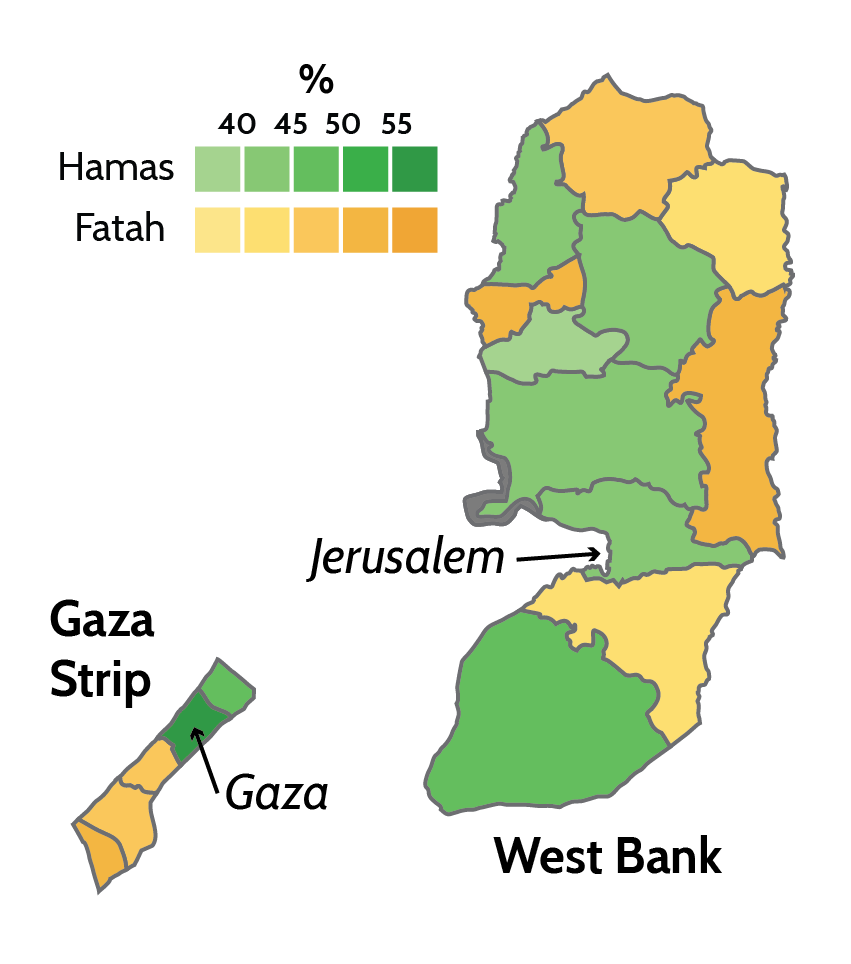
The territory, occupied by Israel militarily since the Six-Day War in 1967, became a coterminous agreement between Israel and the Palestinian Authority (PA) from 1994 onwards, when portions of Gaza came under PA administration, with the exception of Israeli settlements established in the region and military areas dominated by Israeli forces – similar to what can still be seen today in the West Bank. Years later, before the 2006 parliamentary elections, the Israeli government decided, unilaterally and without dialogue with the then Palestinian government controlled by the left-wing Fatah party, to withdraw all its troops from Gaza and dismantle the settlements. What seemed like a positive move ended up strengthening the newest party, Hamas, since the uncoordinated withdrawal from the region generated political instability, since the PA was unable to act directly to develop the region after years of occupation and embargoes of various kinds imposed by Israel2. The final results of the 2006 parliamentary elections saw Hamas win 44.45 per cent of the vote (giving it 74 seats) and Fatah 41.43 per cent (translating into 45 seats).
Results of the 2006 parliamentary elections in the Palestinian territories
The situation quickly became even more unbalanced, with raids carried out by around eight Gaza militants who attacked the Israel Defence Forces (IDF) and kidnapped an Israeli soldier – the military wing of Hamas claimed responsibility for the attack. This episode prompted the Israeli government to launch attacks in both Gaza and the West Bank, causing the destruction of civilian infrastructure and the arrest of several Hamas supporters, including elected members. Israel even arrested 33 Palestinian parliamentarians, even though it claimed that “they were technically members of a terrorist organisation, even though they may not have been directly involved in the terrorist acts”. Following these events, the so-called “Middle East Quartet”, made up of the US, the European Union, Russia and the UN, imposed conditions on the newly-elected Hamas government to recognise the agreements previously signed between Israel and the PA, the recognition of the State of Israel and an end to support for terrorism, which was denied. The Hamas government’s “no” resulted in sanctions being imposed by Israel and the Quartet on both the PA and the two Palestinian territories.
Among certain arguments made in favour of Israel’s actions, both before October 7 and since, is the false premise that “if the Palestinian people voted for Hamas, then they are in favour of terrorism and therefore deserve Israel’s retaliation”. This argument is a dangerous fallacy, not only because it is false, but mainly because it is the basis for the dehumanisation of an entire population.
On the one hand, it is important to emphasise what has been mentioned that in 2006, when Hamas presented itself as a political force, it received 44% of the votes at the time, amid a population of 3.4 million inhabitants3 and just over a million voters (76% turnout)4. Hamas got 440,000 votes, running on a platform that was not based on an Islamic agenda and that spoke of national sovereignty (after years of occupation and repression). In other words, 17 years ago, around 12 per cent of the total population of Palestine voted for a party that promised them something more moderate and sovereignty.
Since then, on the one hand, the Palestinian population has no longer been able to express itself in elections, following the civil war between Hamas and Fatah – which resulted in Hamas controlling the Gaza Strip and the Palestinian Authority, represented by its Fatah president, the West Bank. On the other hand, the Palestinian population has grown to around five million – 38 per cent of whom are under the age of 145. This means that a considerable proportion of the current Palestinian population was not even born when Hamas took power in 2006. More recent data helps us get a more reliable picture of what Palestinians think of Hamas.
In a survey carried out by Arab Barometer6 (a quantitative research centre in the Middle East) in 2023, and reverberated by the prestigious magazine Foreign Affairs7, the confidence of the Gaza population in Hamas was measured. The results show that, among those aged over 30, almost 50 per cent do not trust the Hamas-controlled government “at all”, while more than 20 per cent say they “don’t trust it very much”. Among those aged between 18 and 29, the figures are around 45 per cent and 23 per cent respectively:
“How much do you trust the Hamas-led government?“
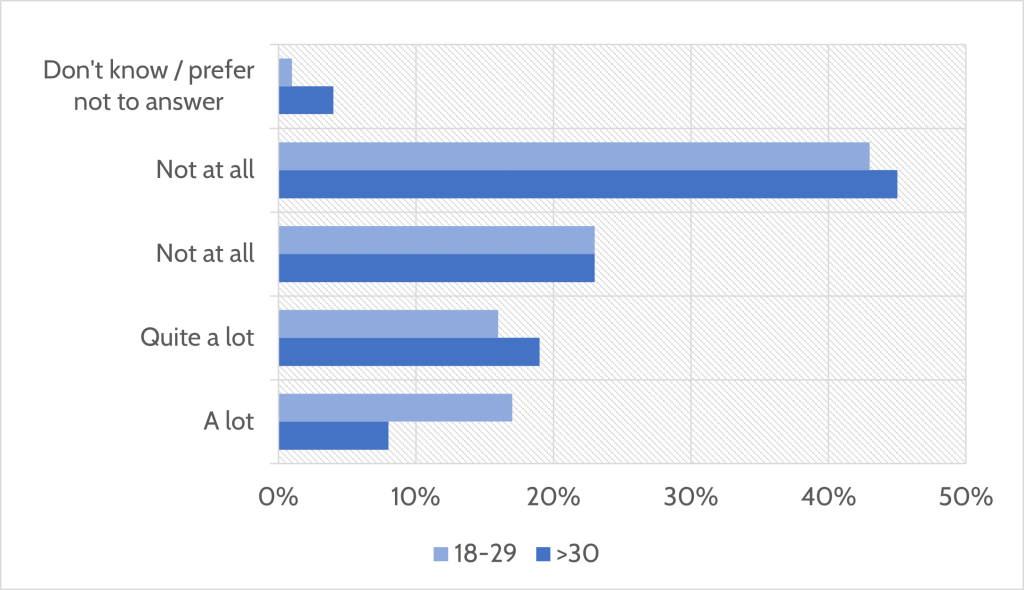
It can be seen, then, that a large part of the population was against the Hamas government and continues to be so. What’s more, with a large proportion of the population being made up of minors, even children and teenagers, it’s clear that the fallacious association of “Palestinians” with “terrorists” is a dangerous distortion of the truth that legitimises the dehumanisation of an entire population at the expense of the actions of a radical minority. Especially in the midst of the great crisis of democracy experienced around the world, in which considerable portions of national populations align themselves with extremists – as seen in Brazil with Bolsonaro, in the US with Trump or in several European countries with the growth of far-right parties/candidates – it is clear to see that a small minority, supported on a one-off basis in an election, can generate international commotions which, in turn, can create fearful situations for the entire population, which often despises these policies. Just as Brazil was not Bolsonaro, the US was not Trump, Palestine – and Gaza in particular – is not Hamas.
Another argument used to justify the carnage carried out almost a month ago by the Netanyahu government is the card that Israel, being a democracy – even the only one in the region – could not do anything against human rights.
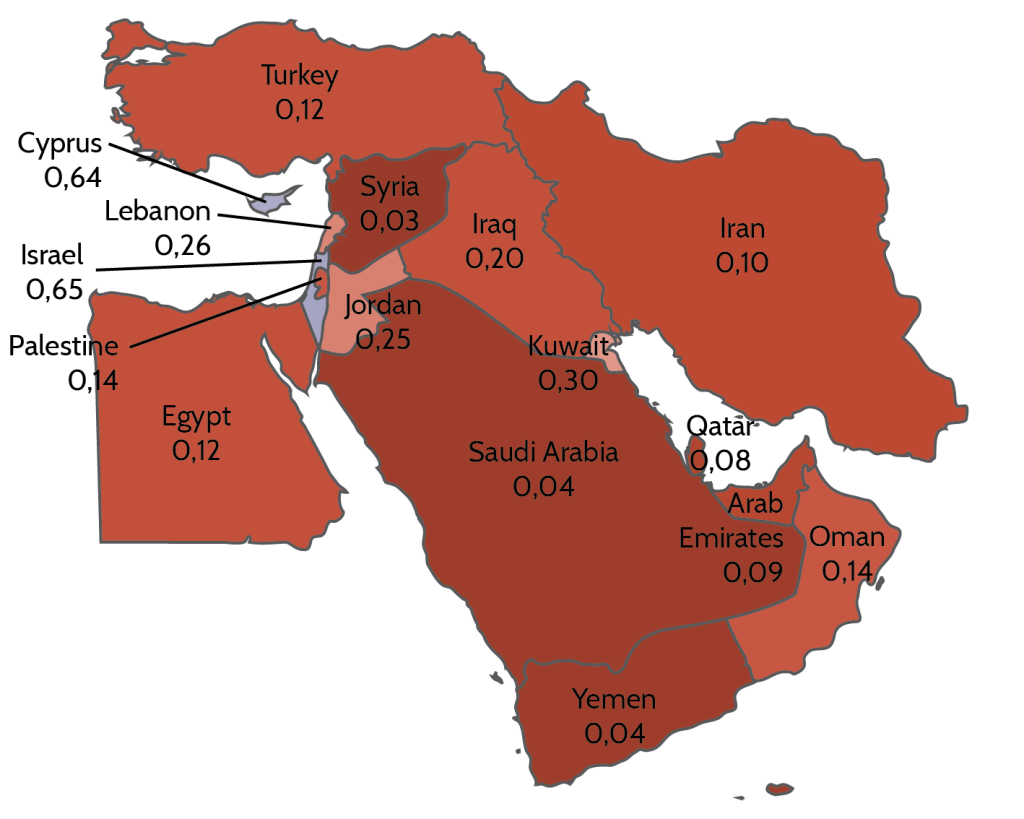
In fact, Israel is the only country in the Middle East – with the exception of Cyprus, which is not always considered part of the region – that can be considered a democracy when looking at scientific indices that analyse the democratic state of a regime. A quick look at the Liberal Democracy Index from the V-Dem database shows that, on a score ranging from 0 to 1, Israel stands out from its neighbours, achieving a rate of 0.65 against figures much closer to 0 in all directions.
Liberal Democracy Index in the Middle East
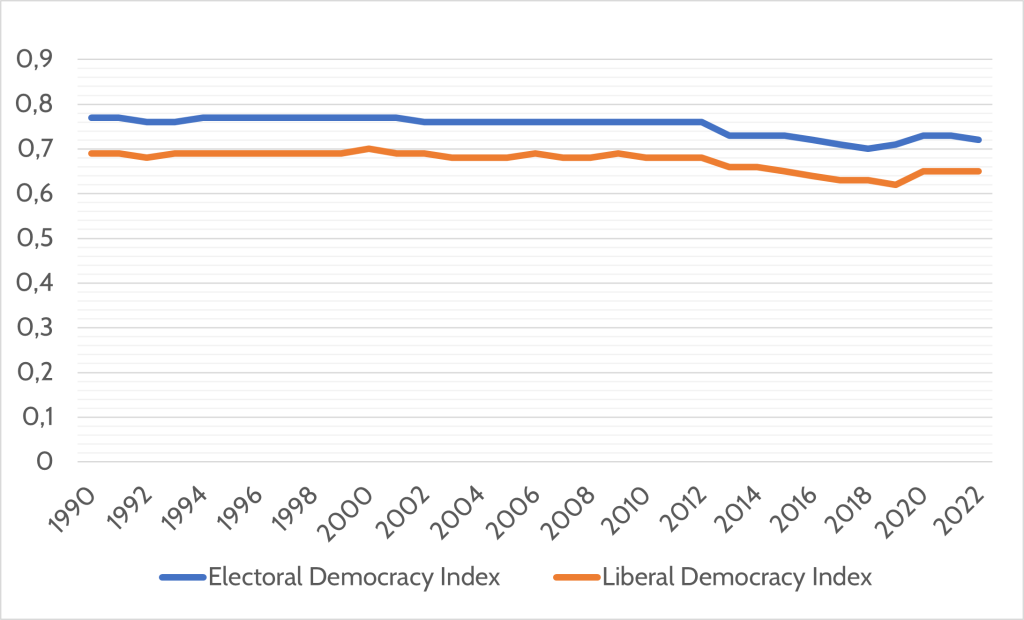
An analysis of the evolution of this same index, however, shows that a drop could be observed during the Netanyahu II government (2009-2021). During this period, Israel’s score fell from 0.69 to 0.62 in 2019 – the lowest entry in the index since 1990. The Electoral Democracy Index, which focuses more on the fair electoral process, also fell by 0.06 points between 2009 and 2018, showing that the Israeli prime minister’s government had a negative impact on the country’s democracy.
Evolution of the Electoral Democracy Index and Liberal Democracy Index in Israel
It’s understandable that Israel’s liberalism has been affected by the Netanyahu government, especially between 2018-2019. During this period, Israel passed the so-called “Nation-State Bill” or, officially, “Basic Law: Israel as the Nation-State of the Jewish People“. This law provides for Israel to be a Jewish state, in which only the Jewish people have the right to exercise their “national self-determination”. The capital was changed from Tel Aviv to Jerusalem – which had already been annexed at the end of the last century, but is not internationally recognised – Arabic was removed as one of the country’s official languages, keeping only Hebrew, and the development of Jewish settlements is encouraged and established as a “national value”. This law cemented a long-standing sentiment of turning non-Jewish citizens into “second-class citizens”, as denounced by the Arab populations8,9 who make up around 20 per cent of the country’s population.
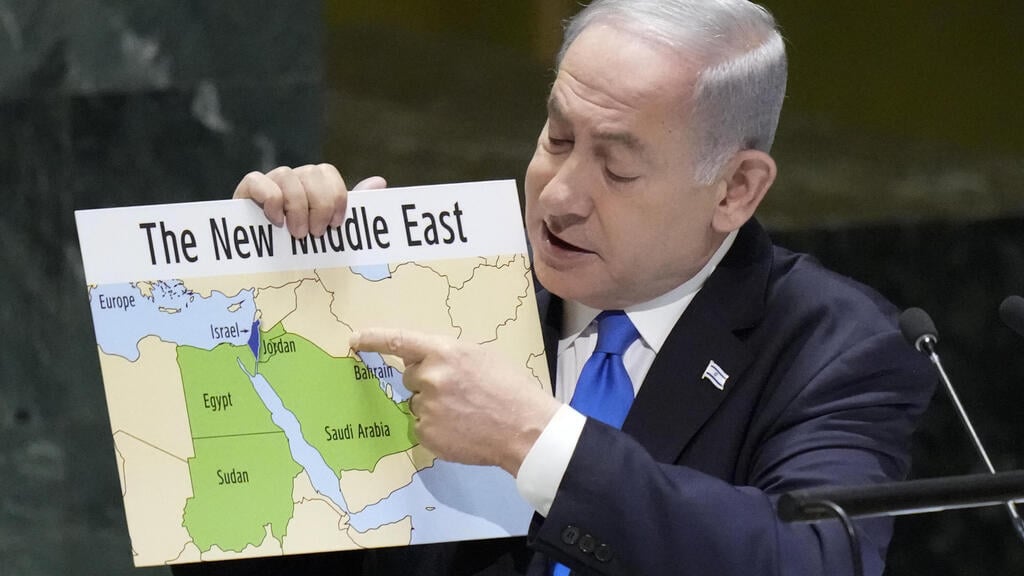
In 2019, Netanyahu would say that Israel “is not a state of all its citizens”, being exclusively a state for Jews10, even though he emphasised that other peoples “have the same rights as all of us”. In fact, Netanyahu and his Likud party have been fervent in their demonisation of Israel’s Arab populations. In his speech at this year’s UN General Assembly in September, Netanyahu appeared with a map of the “New Middle East” on which he shows the entire territory of the former British Mandate of Palestine under Israeli control, i.e. including the entire West Bank and Gaza.
In addition to the liberal problems involving Arab minorities in Israel, Netanyahu has also worked to undermine the country’s judiciary, which is why for months thousands of Israelis have taken to the streets in Israel to protest against the government. With the intention of limiting the powers of the judiciary, the Likud government’s proposal is seen as an attack on Israeli democracy, a fact that Netanyahu always minimises11. Observing the plans to undermine the strength of the judiciary in the country within a large global context in which other democracies see their leaders with authoritarian biases following the same playbook makes questioning the democratic commitment of Netanyahu and his party quite pertinent.
Beyond the domestic scene, it’s palpable how Israel seems to have completely given up on diplomacy and shifted to a confrontational foreign policy, like so many countries ruled by authoritarian leaders – perhaps worse. It’s not news that the Israeli government has a history of resembling many tantrum-throwing tweeters in its social media posts. Exchanges of barbs with the official government account of Iran, Israel’s number one enemy, through memes and GIFs illustrate this.
Since the terrorist attacks at the beginning of October, however, this behaviour has become the country’s standard. In addition to the very strong propaganda attempting to directly associate Hamas with the Islamic State and the people of Palestine (both Gaza and the West Bank) as “terrorists”, the Israeli government has started attacking anyone who denounces its clear violations of international law.
The United Nations has become one of Israel’s declared enemies after denouncing the murder of its workers by Israeli bombing raids in Gaza and the collective punishment of a population of 2.2 million people who are without water, food and electricity, totally physically cut off from the rest of the world. The Israeli government has not only “called for the head” of UN Secretary General Antonio Guterres for saying that the Hamas terrorist attacks “did not occur in a vacuum”, referring to the decades-long occupation of the Palestinian territories and Israel’s Apartheid policy in the West Bank, but has also denied visas to UN diplomats. For Israel, “the time has come to teach them a lesson”12 (at the UN) and “cut off their funding”13 until “the bias and anti-Semitism stops”.
“Anti-Semitism“, which means having views or prejudices against Jews or Judaism, has become Israel’s watchword for any person, institution or country that dares to question them, completely misrepresenting a term that is very heavy and has already proven to have devastating consequences for the Jewish people throughout human history. For a government that transformed the State of Israel, until then a country like so many others, into an “essentially Jewish” state – as of the entry into force of the aforementioned law – it makes sense that criticising the country would be seen by them as anti-Semitism. Nevertheless, a country cannot be allowed to defend itself against valid criticism, or calls for it to follow the basic principles of international and human coexistence, by using a misrepresentation of these proportions.
Not only has the UN been labelled anti-Semitic, but also international leaders and movements such as the young Greta Thunberg14, leader of the ecological movement “Fridays for Future”, or even countries that have shown solidarity with the pain of Palestinian civilians who are victims of Israel’s non-stop bombardments, which have been labelled by Israeli officials as “non-democracies”.
The most striking thing is that Israel, with its campaign to destroy Gaza – officially the “destruction of Hamas”, “Hamas” being understood as “Palestine” by many in the Israeli government – is simply destroying any already fragile beliefs in an international community based on the defence of human rights, as propagated so much by the West. If this was an agenda defended by the majority of countries in the West (or also the “Global North”) a year ago when Russia was invading Ukraine, also illegally, with a discourse denying the country’s right to exist, the exact same policy adopted by Israel finds favour in these same countries.
Demonstrations in support of Palestinian civilians are banned and labelled “pro-terrorism” and “anti-Semitic” in European countries such as France15 and Germany16, but also in the US. Even Jews who oppose the war led by the Netanyahu government are labelled anti-Semitic and imprisoned17.
Also at the United Nations, the US has shown that it has no interest in defending human rights in areas that it considers important to its interests, since it vetoed the proposal made by Brazil at the Security Council which, on the one hand, condemned Hamas’ terrorist attacks, but, on the other, called for humanitarian pauses so that food and water could be brought to the civilians suffering under Israel’s siege of Gaza18.
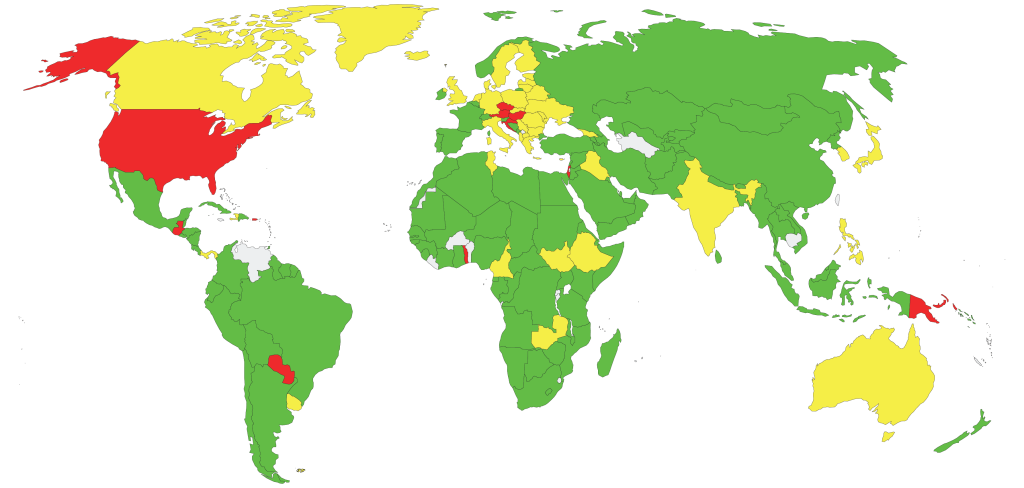
At the UN General Assembly, 120 countries voted in favour of the resolution aimed at protecting civilians and upholding legal and humanitarian obligations in Gaza. Once again, with the exception of countries like France, Ireland and Portugal, the West has shown itself to be against the defence of human rights, voting against or abstaining – on a resolution that would not even be binding, in other words, it is only symbolic.
Result of the vote on the resolution for a “humanitarian truce” and civil protection at the United Nations General Assembly – 27 October 2023
This latest episode in the long-running conflict between Palestine and Israel will take a long time to come to an end. The Israeli government itself says that the operation in Gaza “will last for months”. The human situation, for the time being, is catastrophic. The global effects could be even more so. If recent developments, such as the abandonment of countries from the Global South during the race for vaccines during the pandemic years or the clear predilection for “their own” shown by the actions of countries from the Global North in their swift action against Russia in illegally invading Ukraine, already signalled that the global order headed by the West was already weak and based on fallacies and “nice” terms that were quickly forgotten as soon as their interests spoke louder, the “blind eye” turned by these countries to the massacre of thousands of Palestinian civilians on the basis of atrocities committed by a terrorist group – which is not even supported by these populations – makes it clear to countries of the Global South (of which Brazil has an interest in being one of the prominent leaders) that negotiating with the North does not bring them many benefits.
This, in turn, creates incentives for the formation of new constellations of international politics which, given the regimes of some of the large countries in this group, do not promise to be any more positive than the order that has governed the world until now. By emptying multilateral forums such as the United Nations, these Western countries end up creating the conditions to weaken not only themselves, but also, and above all, the values they claim to defend. The weakening of human rights at a global level, led by a blind defence of an extremist regime that aims to annihilate a people, could cost humanity dearly.
1 Bouris, Dimitris (2014). The European Union and Occupied Palestinian Territories: State-building without a state.
2 https://www.britannica.com/event/Israels-disengagement-from-Gaza
3 https://data.worldbank.org/indicator/SP.POP.TOTL?locations=PS
4 https://www.electionguide.org/elections/id/1433/
5 https://data.worldbank.org/indicator/SP.POP.0014.TO?locations=PS
6 https://www.arabbarometer.org/media-news/what-palestinians-really-think-of-hamas/
7 https://www.foreignaffairs.com/israel/what-palestinians-really-think-hamas
8 https://www.theguardian.com/world/2018/jul/19/one-more-racist-law-reactions-as-israel-axes-arabic-as-official-language
9 https://www.haaretz.com/2018-07-20/ty-article-opinion/by-degrading-arabic-israel-has-degraded-arabs/0000017f-db8c-d3ff-a7ff-fbac400d0000
10 https://www.theguardian.com/world/2019/mar/10/benjamin-netanyahu-says-israel-is-not-a-state-of-all-its-citizens
11 https://edition.cnn.com/2023/09/12/middleeast/israel-judicial-overhaul-supreme-court-intl/index.html
12 https://www.timesofisrael.com/israel-halts-un-staff-visas-as-officials-pan-guterress-truly-insane-hamas-remarks/
13 https://twitter.com/giladerdan1/status/1718680059614036093
14 https://economictimes.indiatimes.com/news/international/uk/greta-thunbergs-pro-palestine-post-sparks-controversy-over-alleged-anti-semitic-symbol/articleshow/104643642.cms
15 https://apnews.com/article/france-israel-palestinians-war-protests-banned-5626bafec480b32226dcb97d0c92a553
16 https://www.aljazeera.com/features/2023/10/26/complete-censorship-germanys-palestinian-diaspora-fights-crackdown
17 https://www.theguardian.com/world/2023/oct/19/jewish-protest-israel-gaza-washington-dc
18 https://edition.cnn.com/2023/10/18/europe/us-veto-security-council-israel-gaza-war-intl/index.html
19 https://news.un.org/en/story/2023/10/1142932