Drones, Mercenaries, and Rare Earths: The New Dynamics of Conflict in the Eastern DRC
By Nicolas Zupardo Dutra 21/06/2026 8 min
"Cry 'Havoc!' and let slip the dogs of war!" Mark Antony's famous line from Julius Caesar seems to describe with precision the current state of conflict in eastern Democratic Republic of Congo. More than two decades after the formal end of the Second Congo War, the region remains marked by competition over strategic mineral resources. In recent years, the resurgence of operations by the M23 rebel movement, backed by Rwanda, has coincided with the entry of new foreign actors into the Congolese theater of war — including private military companies — and new technologies such as drones. It is within this context that the armed conflict in eastern Congo has been drawing increasing attention on the international stage.
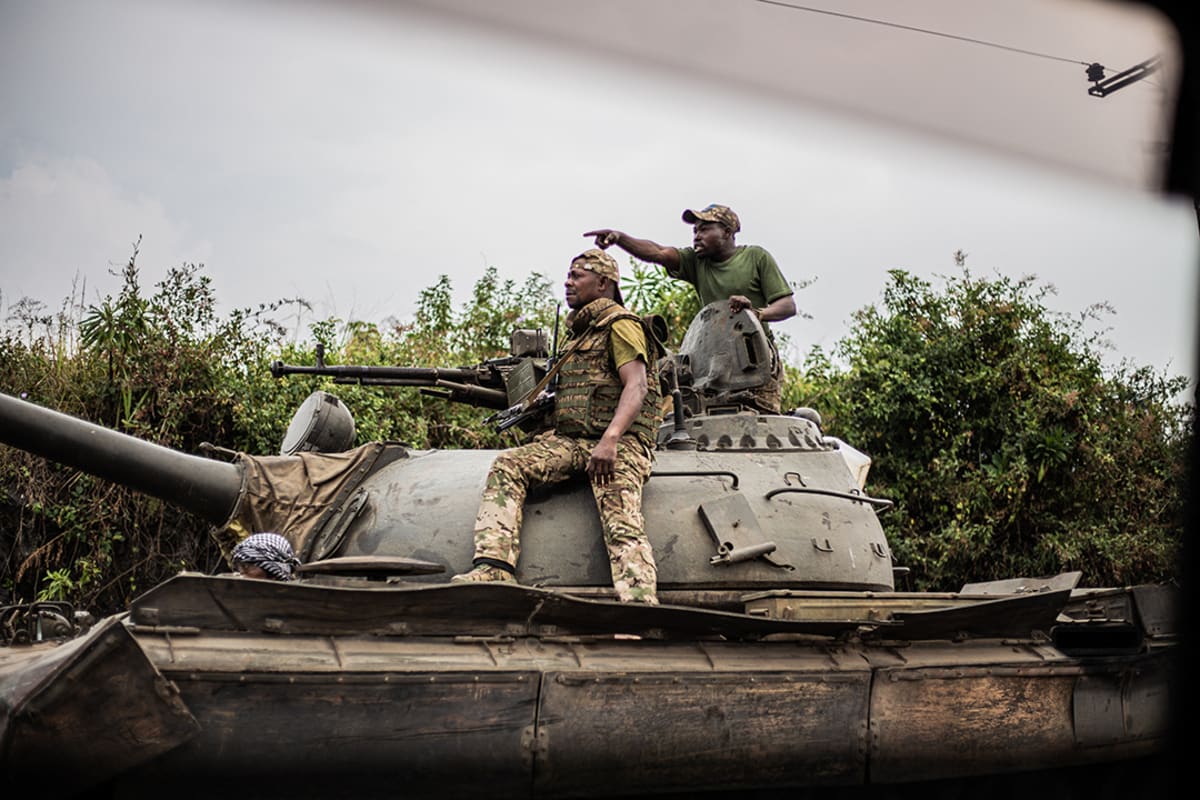
Soldiers of the Armed Forces of the Democratic Republic of Congo (FARDC) during operations on the outskirts of Goma in 2025. Credit: Jaspin Mwisha/AFP
The Roots of the Conflict in Congo
The conflict in eastern Democratic Republic of Congo has its roots in the 1994 Rwandan Genocide, which generated a massive flow of Hutu refugees into Congolese territory, including extremist militiamen. This process triggered the First Congo War (1996–1997), in which Rwanda and its allies overthrew the dictator Mobutu Sese Seko and brought Laurent Kabila to power. The relationship between Kabila and Rwanda quickly deteriorated, sparking the Second Congo War (1998–2002), a continental-scale conflict involving multiple countries that resulted in more than three million deaths. Despite peace agreements signed between 2002 and 2003, and the subsequent election of Joseph Kabila in 2006, instability in the eastern part of the country persists. Rebel groups such as M23, composed mostly of ethnic Tutsi members and backed by Rwanda, continued to fuel the conflict in the decades that followed. Added to this is the dispute over strategic minerals such as cobalt and copper, abundant in the region and essential to the global electronics industry, which has created new incentives for local and foreign actors to perpetuate violence.
Currently, the conflict remains active despite political efforts supported by the United States and its partners to secure a ceasefire and a negotiated peace agreement. The Democratic Republic of Congo and M23 signed, in November 2025, a framework peace agreement mediated by Qatar, which charted a path toward a comprehensive, long-term settlement. However, no ceasefire has been consolidated, and the security situation in the region continues to deteriorate, despite efforts by international and African bodies, such as the African Union and MONUSCO, to support ceasefire implementation. The two parties met again for a new round of peace negotiations in Switzerland in mid-April, for the first time since early February, and signed new technical agreements to help implement the first two pillars of the deal, including a prisoner exchange initially agreed upon at the end of 2025. However, the Congolese government has reportedly been delaying the prisoner exchange process, and various disagreements have blocked progress toward the third pillar in the Swiss negotiations, while both sides continue to trade accusations of ceasefire violations.
Peace negotiations remain largely at an impasse due to procedural disputes, mutual distrust, and deep-seated disagreements. UN observers assess that both the DRC and M23 continue to prioritize military force as a means of resolving the conflict. It is in this context that both sides are seeking to expand their military capabilities through the introduction of drones, frequently relying on foreign mercenaries to operate such weaponry.
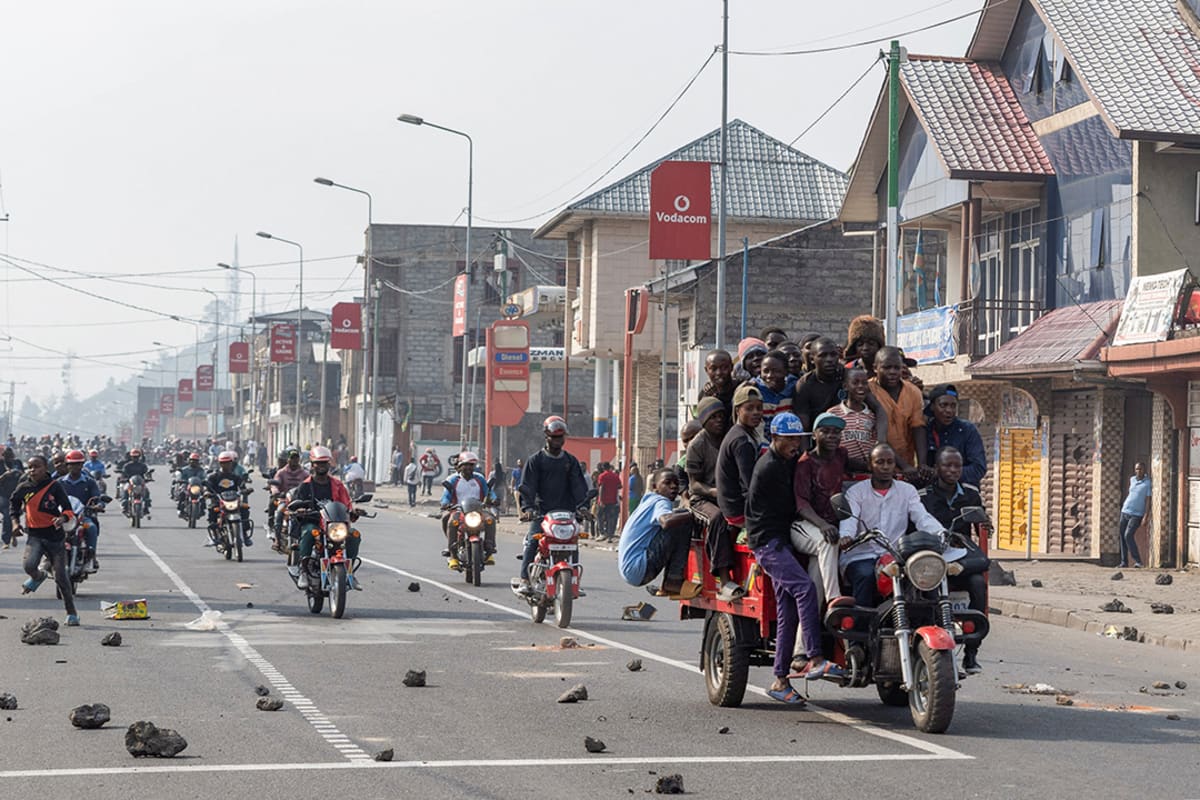
Congolese civilians take part in a demonstration demanding justice following the killing of protesters protesting against the United Nations Stabilization Mission in the Democratic Republic of Congo (MONUSCO) in Goma, 2023. Credit: Arlette Bashizi/Reuters
New Actors and New Weapons
It is within this framework that a new contingent of Latin American mercenaries, hired by a company based in the United Arab Emirates (UAE) and linked to war crimes in Sudan, has reportedly been deployed to eastern DRC to support the Congolese government in its war against the Rwanda-backed M23 rebels. The Paris-based investigative outlet Intelligence Online reported on April 22 that agents linked to the UAE-based private military company Global Security Services Group (GSSG) have been recruiting drone pilots from Latin America who operate in Kyiv, Ukraine, to fight M23 in the DRC. The report stated that an initial contingent of mercenaries had recently been sent to the Kivu region in eastern DRC.
This recent development raises two central concerns. First, there is the potential for human rights violations by foreign combatants during their operations in Congo. This concern is warranted given GSSG's track record, the company has the backing of the UAE government and, over the past year, has been implicated in sending mercenaries to Sudan to support the Rapid Support Forces (RSF) against the country's armed forces in the Sudanese civil war since late 2024. The security analysis organization Conflict Insights Group assessed that fighters linked to GSSG were involved in mass atrocities committed during the RSF's siege and capture of El Fasher, Sudan, in October 2025. The U.S. Department of the Treasury imposed two rounds of sanctions against recruitment networks of Colombian companies and individuals, including a retired Colombian colonel based in the UAE with ties to GSSG, related to the conflict in Sudan between December 2025 and April 2026.
Furthermore, the most recent mobilization of private military companies (PMCs) in the eastern DRC conflict indicates a deepening of the Congolese government's historical reliance on foreign fighters. The Congolese president began to further increase dependence on PMCs and allied armed forces in December 2025, when the DRC suffered a major military setback after the M23 rebel group captured the city of Uvira, in South Kivu province, with the support of the Rwandan Defence Forces (RDF). Algerian, Colombian, Israeli, and Turkish mercenaries have been spotted at the Congolese army's (FARDC) main air base in Kisangani, in central DRC, since late 2025, operating fighter jets and drones for the Congolese armed forces.

DJI Mavic 3 drone flying on the outskirts of Goma, 2025. Author unknown.
Also noteworthy is the involvement of PMCs linked to Erik Prince, an American businessman, founder of the now-defunct Blackwater, and informal advisor to current U.S. President Donald Trump. According to Reuters, mercenaries linked to Prince were deployed to South Kivu to assist Congolese forces in retaking Uvira and have since been supporting pro-government Congolese forces against the M23 coalition in South Kivu. This development is significant given Erik Prince's longstanding interest in Congo's mineral deposits.
As early as 2023, Prince was associated with a proposal that would have seen the deployment of more than 2,000 mercenaries from Colombia, Mexico, and Argentina to North Kivu, with the aim of protecting mining areas and containing the advance of M23 rebels. That plan, brokered by the UAE, did not materialize, and no formal agreement was reached. Similarly, earlier discussions about deploying thousands of fighters to eastern Congo also failed to result in a contract. More recently, in 2025, Erik Prince closed a contract worth approximately $700 million with the Congolese government to assist in the protection and taxation of DRC's mineral resources, particularly in the copper-rich province of Katanga. With the recent confirmation of Prince-linked mercenaries on the front lines in Kivu, it is possible to assert that this involvement points to a troubling convergence between private security initiatives and interests tied to mineral extraction in eastern DRC.
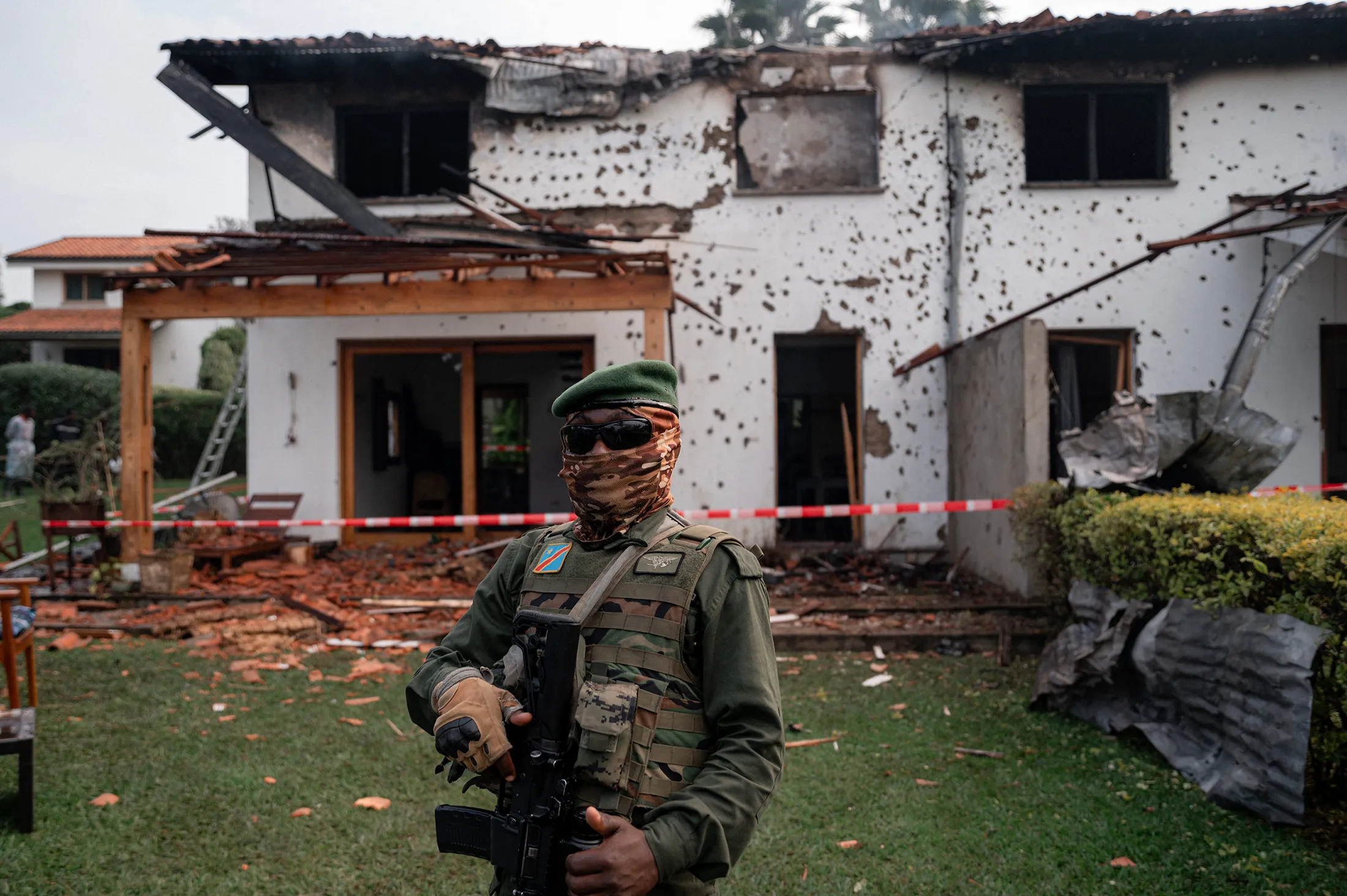
Soldier of the Armed Forces of the Democratic Republic of Congo (FARDC) in front of a residence damaged by a drone attack, Goma, 2026. Credit: Jospin Mwisha/AFP
Rwanda, Drones, and the Conflict in Eastern Congo
M23 has also continued to reinforce its aerial warfare capabilities using personnel and weaponry supplied by foreign countries, with this support coming predominantly from Rwanda. Rwanda's military backing is long-standing and includes a wide range of weapons systems, among them surface-to-air missiles, artillery, and electronic warfare equipment. Recently, however, it is possible to observe the gradual introduction of drones into M23's arsenal. In March, M23 fighters, or militias allied to M23, attacked FARDC positions and those of the Wazalendo force, a pro-government militia, in the South Kivu highlands, using drones for the first time. The one-way attack (OWA) drones reportedly used by M23 in the operation resemble the Turkish-manufactured Yiha III variant, which M23 is said to have used in at least two attacks on Kisangani since the beginning of the year. Media sources aligned with the Congolese government have also claimed on several occasions since mid-April that M23 and the RDF carried out attacks in the South Kivu highlands using Turkish-manufactured TB2 drones launched from Rwanda.
Rwanda's current military support is identified as a critical component of M23's military advances, a concerning development given the group's history of human rights violations. Since its founding, M23 has been accused by international bodies of summary executions, forced displacement, child soldier recruitment, and attacks against civilians in eastern DRC. More recently, following the capture of Uvira earlier this year, local accounts and reports from humanitarian organizations pointed to episodes of looting, sexual violence, and reprisals against communities perceived as sympathetic to the Congolese government. The group's growing military sophistication, driven by Rwanda's support, significantly escalates the conflict and further aggravates the humanitarian crisis in the region. The implications of this security deterioration are particularly alarming in light of the recent Ebola outbreak recorded in eastern Congo, as the continuation of fighting hampers humanitarian operations in a region already marked by institutional fragility and mass displacement.
Conclusion
The conflict in eastern Democratic Republic of Congo is entering a new phase characterized by increasing internationalization of the war, the introduction of sophisticated military technologies such as drones, and the expanding role of mercenaries and private military companies. Rwanda's support for M23, combined with the growing convergence between private security and mineral extraction, contributes to deepening regional instability and perpetuating violence in eastern Congo. At the same time, the humanitarian impacts of the conflict continue to worsen, undermining diplomatic efforts, humanitarian operations, and even the containment of outbreaks such as Ebola. In this context, the war in eastern DRC has ceased to represent merely a regional insurgency, having come to incorporate elements characteristic of contemporary conflicts, combining geopolitical competition, competition over strategic resources, transnational armed actors, and increasing technological sophistication.