A decade outside the EU: What is the assessment 10 years on from Brexit?
By Caio Ponce de Leon Ribeiro Freire 27/06/2026 26 min
This week marks a decade since voters in the United Kingdom decided in a historic referendum to leave the European Union. Brexit, which won with nearly 52% of valid votes, promised to "bring back independence to the United Kingdom", taking political decisions away from Brussels and returning them to Westminster. However, what is the balance sheet of these last ten years?
A marriage with a troubled start and doubtful commitment
Before discussing what happened afterwards, it is important to understand what happened beforehand. The history of the United Kingdom with the European Union, or with the "European Communities", as they were called at the time, was never one of great love. In the early days of European integration, in the 1950s, London did not join the countries of the continent, for instance. At the time, still possessing its Empire, the United Kingdom did not consider it advantageous to join an association of countries that were relinquishing national sovereignty over decisions concerning a product so important to the national economy: coal. Thus, in the first agreement that set European integration in motion, the European Coal and Steel Community (ECSC), London preferred to stay out. Beyond that, the British government was not in favour of supranational policies, unlike the six ECSC countries. Instead, it preferred intergovernmental agreements, where national governments played the leading role1. For this reason, the United Kingdom joined several other European countries that had also not adhered to the supranational plans of the Communities and founded the "European Free Trade Association", a project almost entirely opposed to that of the European Communities, based on intergovernmentalism rather than supranationalism.
The imperialist vision of the United Kingdom would begin to crumble quite soon. The Suez Canal Crisis of 1956 showed that the power and influence of the United Kingdom were waning. As a consequence, territories of the Empire began to gain independence at an ever-increasing pace. Still in the 1950s, London ceded control of Sudan, Ghana, and Malaya. In the early 1960s, it was the turn of Nigeria, British Somaliland (present-day Somalia), Cyprus, Sierra Leone, and Tanganyika, all between 1960 and 1961. These accelerating changes led London to make a radical shift in its foreign policy and begin to understand that its economic future was more closely tied to the European continent than to overseas territories. It was in this context that the British government applied to join the European Communities as early as July 1961.
However, British entry would not be so straightforward. At the helm of the Élysée Palace was President Charles de Gaulle who, holding his own highly nationalist and anti-American vision, blocked London's application. For de Gaulle, the United Kingdom was a "Trojan Horse" for American influence in Europe, as well as being "anti-European". For this and other reasons, he vetoed on two occasions (1963 and 1967) the country's entry into the bloc. Only after his departure from the French presidency, from 1969 onwards, did the United Kingdom manage, on its third attempt, to join the other countries of the Communities, officially entering in January 1973.
The first Brexit, however, could have come almost two years after its entry. In June 1975, the Labour government called upon the electorate to answer the question "Do you think the United Kingdom should stay in the European Community (Common Market)?" in the first referendum on the country's participation in the European integration process. With approximately 64% turnout, the "yes" vote won at the time with 67% of votes2, demonstrating strong support for maintaining the country within the Communities.
However, since British entry into the group of other European countries came about more through pragmatism (or the necessity of remaining alongside important trading partners) than through conviction regarding supranational policies, the United Kingdom was a clear example of what many call a "loveless marriage" or, as some analysts put it, "wanting the benefits of being married whilst remaining single". This can be seen, for example, in London's decision to remain outside the Monetary Union, which would give rise to the Euro some years later. At the time, Labour ran a campaign in which they promised to take the country out of the Communities should they be elected, but this time without even calling a referendum. Having lost to Margaret Thatcher, they would subsequently change their political strategy of positioning themselves against the Communities.
Other occasions on which the United Kingdom remained outside the more federalist advances of the European Union (officially under this name from 1993 onwards) included the Schengen Agreement, which abolished internal borders between most member states (the agreement responsible for it being possible today to travel from one EU country to another without requiring additional visas), the Charter of Fundamental Rights of the European Union (from which they partially opted out), European legislation passed in the area of "freedom, security and justice" (which includes the harmonisation of private international law, extradition agreements, visas and migration policy).
Turbulence leading to divorce
London's relationship with Brussels was always more different than that of other member states. The academic Stephen George designated the United Kingdom as an "awkward partner" in his 1990 book3. This is because the British consider themselves to have an identity and culture distinct from continental Europe, a "special relationship" with the United States (already mentioned by de Gaulle as a reason for blocking the country's entry previously) and a stronger association with the countries of the so-called "Anglosphere" (which includes many of the former colonies).
British public opinion regarding the European Union varied throughout the history of the relationship between the two actors. As data from the Eurobarometer shows, the total number of respondents who considered that the country did not benefit from being a member of the EU remained ahead of the total of those who viewed EU membership favourably. In the late 2000s, at the time of the 2009 financial crisis, the gap between the two sides widened, with nearly 60% of British respondents stating that the country did not benefit from being in the Union.
The image of the European Union amongst British citizens tended to be predominantly negative during the 2000s and 2010s, prior to the referendum, reaching its peak around 2011, following the height of the 2010 Eurozone Crisis.
A political signal of this not-so-amicable relationship between the British and the EU can be seen in the role that "UKIP" (the UK Independence Party), a Eurosceptic party, played from the 1990s onwards. Formed in the same year that the Maastricht Treaty came into force, which officially created the European Union in 1993, UKIP managed to break the hegemony of the two traditional British parties, Labour and the Conservatives, finishing third in the 2004 European Parliament elections, then second in 2009 and, finally, first in 2014 (with approximately 27% of British voters' votes). Nigel Farage, the party's most prominent politician, became a figure who embodied British anti-EU sentiment. Despite its strength in European Parliament elections, of the eight national British elections in which it participated, UKIP only managed to win a seat on a single occasion, in 2015, when it achieved 12% of the vote4.
Finally, a new referendum would be proposed, this time by the Conservatives. Following growing pressure within the party since 2012, the then Conservative Prime Minister David Cameron promised that if his party won the next general election in 2015, he would negotiate better conditions for the country's continued membership of the European Union and would subsequently call a popular vote on the matter. It was during this period that UKIP achieved its greatest victory in the European elections and, the following year, won its first seat in the House of Commons, the British parliament. The Conservatives came out ahead, obtaining approximately 37% of the vote, against 30% for Labour. Cameron remained as Prime Minister and, as promised, took the idea of the referendum forward.
In negotiations with Brussels, Cameron brought forward the United Kingdom's demands: that the country should have greater influence in economic governance (dictated, as a rule, by the European Central Bank), that the EU should officially recognise that Eurozone policies did not apply to countries that did not have the Euro (which already did not apply), that countries outside the Eurozone had no obligation to bail out struggling economies that used the Euro as their currency, that the United Kingdom should be legally exempt from any federalist advances by the EU (which was, in practice, already a reality), that national parliaments should be able to veto European laws (which, under the 2009 Lisbon Treaty, was already possible) and, finally, that the United Kingdom should be able to prevent other EU citizens who emigrated to the United Kingdom from claiming social housing or workers' benefits until they had spent a minimum of four years in the country (something that was vetoed by European law, since every EU citizen must be treated equally in all member states)5. The majority of these demands were, in fact, agreed to the United Kingdom by Brussels. Nevertheless, as it was a campaign promise, the referendum went ahead.
The legislation passed in the House of Commons to approve the referendum was the so-called "European Union Referendum Act" and was passed at the end of 2015. The law provided for a referendum to be held before the end of 2017, but was not designed to be binding. That is to say, the result of the referendum had no legal validity and the government had no obligation to take the result into account when legislating. This fact showed how the referendum was originally planned more as a way of "sounding out" the British electorate than of actually asking the people to legislate. The British Supreme Court reaffirmed this non-binding character after the vote in 2016.
Finally, the date was chosen: 23rd June 2016. The ballot paper asked: "Should the United Kingdom remain a member of the European Union or leave the European Union?", with the options: "Remain a member of the European Union" and "Leave the European Union".
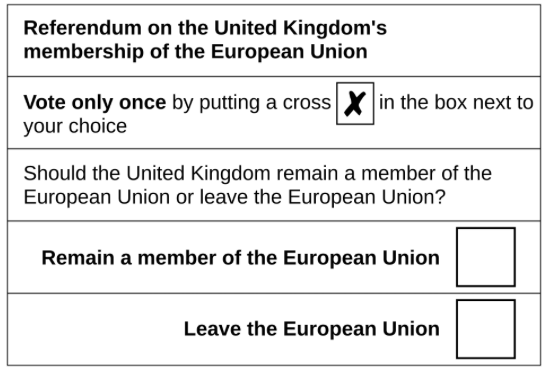
Ballot paper
In February 2016, the government of Conservative Prime Minister David Cameron declared its support for the United Kingdom remaining in the European Union. This officially marked the start of the campaign for "Brexit" (a term coined from "Britain" and "Exit").
Officially, the Electoral Commission declared the "Britain Stronger in Europe" movement as the official campaign vehicle for the "remain" side and the "Leave.EU" movement, led by Nigel Farage, as the official campaign for the "leave" vote. This meant that these committees received public funding of seven million pounds to canvass the electorate for their side. The government maintained its support for keeping the United Kingdom in the European Union, but released its ministers to vote and campaign for whichever side they chose.
As the government was in favour of keeping the United Kingdom in the EU, it prepared an informational leaflet setting out the arguments for the country remaining as a member of the Union. This decision was criticised by members of the campaign to leave the EU, most notably Farage, who stated that if "remain" won, another referendum would be necessary, because the government had enjoyed an unfair advantage6. On the other hand, the campaign in favour of Brexit was strongly criticised for running a disinformation campaign, exploiting the majority of the British electorate's lack of knowledge about how the European Union functioned and instrumentalising it in favour of leaving the bloc78. Tabloids in particular, which were accustomed to exploiting sensationalist headlines and leveraging fear as a means of monetising their operations, were seen as important factors in boosting the campaign in favour of leaving the EU9.
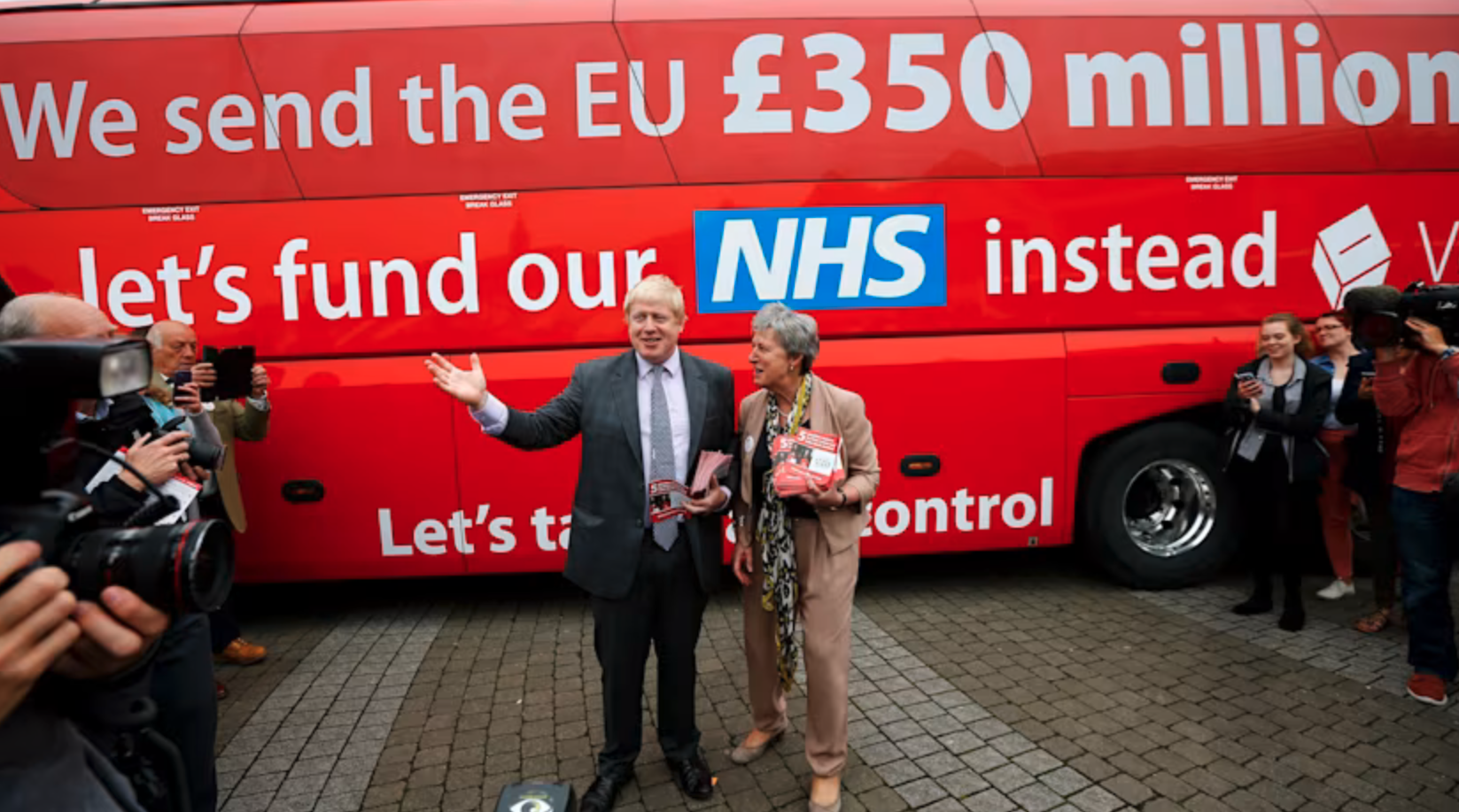
The Leave campaign bus, with Boris Johnson (who would later become Prime Minister) at the front, claiming that £350 million sent to the EU would be invested in the National Health Service (NHS) in the event of leaving the European Union
Finally, the British electorate expressed itself in favour of the United Kingdom leaving the European Union, with the leave vote having garnered 51.8% of votes, against 48.1% in favour of remaining. Voter turnout was 72%. Looking at the voting map, one can see that the vote to leave the EU was more concentrated in England and Wales. Scotland and Northern Ireland, on the other hand, voted predominantly in favour of remaining in the bloc, which would subsequently reignite those territories' interests in becoming independent from the United Kingdom.
1975 vote 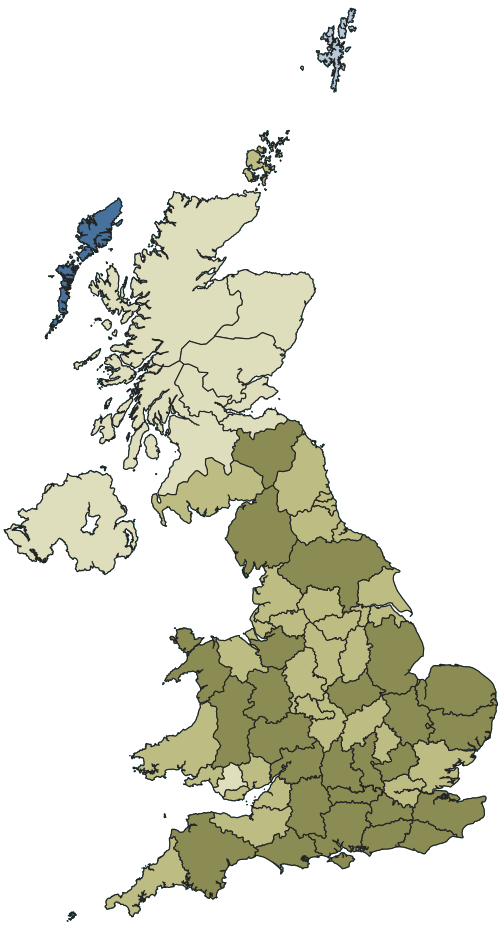 | 2016 vote 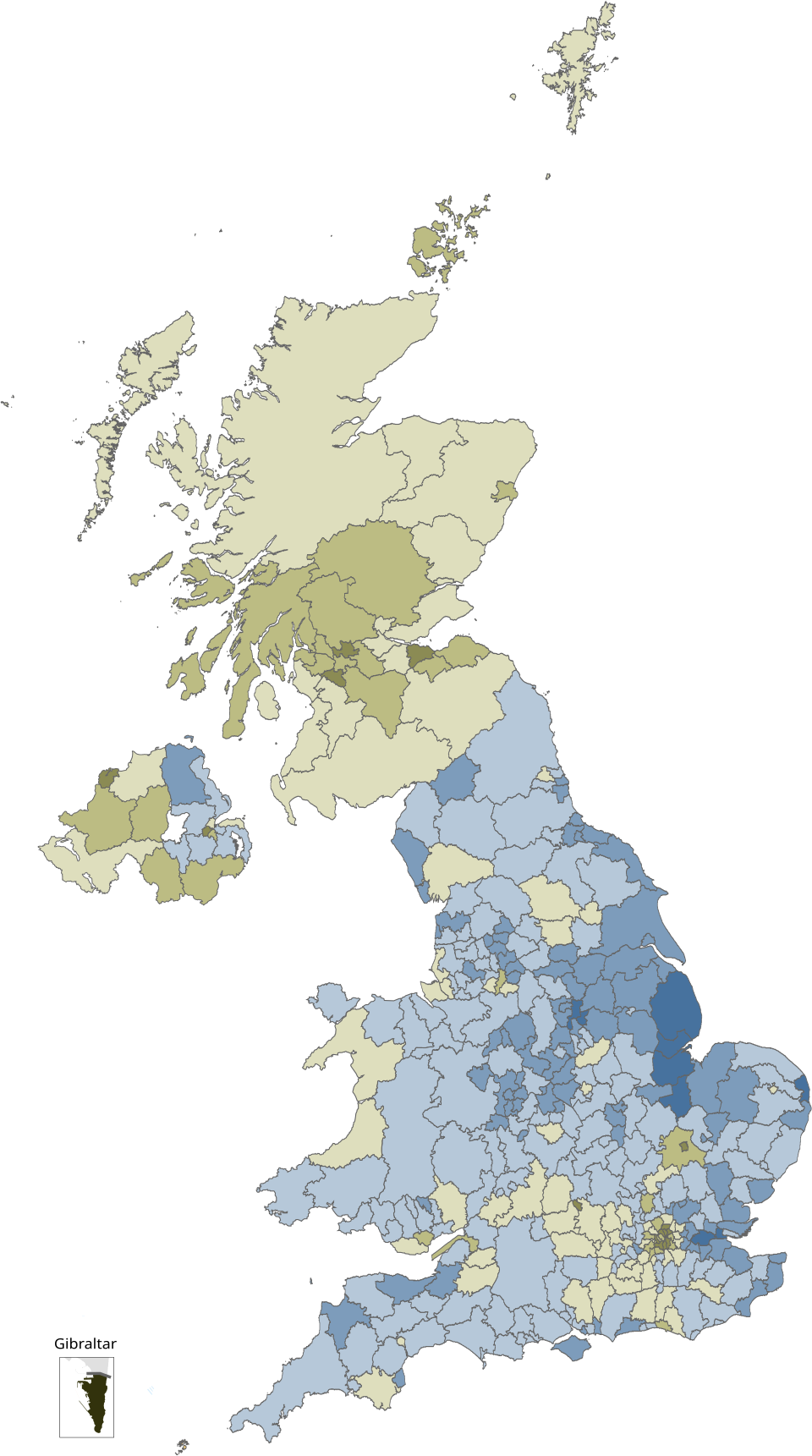 |
Source of maps: Wikipedia
A decade on, what is the balance sheet?
Let us now move forward ten years to look back in retrospect at what has changed in the United Kingdom's indicators since the vote. It is important to note, however, that it has not yet been ten years since the United Kingdom actually left the European Union.
Following the June 2016 vote, the negotiations to disentangle from the European Union were, as expected, extremely arduous. Given that it is a supranational organisation that is strongly intertwined with the day-to-day functioning of its member states, and vice versa, leaving the European Union is not as simple a task as merely withdrawing from a club.
Dormant issues such as the division of the Irelands, which had been pacified by the United Kingdom's earlier entry into the European Union, resurfaced, given that this is the principal territory of the country (Northern Ireland) that shares a land border with a member of the European Union (the Republic of Ireland). The movement of people and goods with the recreation of a hard border between the two territories was in itself an issue that took years to negotiate.
The (largely, but not yet entirely complete) disentanglement of the United Kingdom's economic, political and social structures from the European Union only came to fruition almost four years later, in February 2020. That is to say, of the ten years since the referendum, the United Kingdom has only officially been outside the European Union for six and a half years. The other four were spent merely negotiating the actual departure. Let us therefore examine a few crucial points from the Brexit campaign in order to analyse the effects of departure on British daily life since then.
Migration
Without doubt, migration was one of the main points of the Brexit campaign. This is because, after all, 2016 was at the height of what became known as the "Refugee Crisis", when millions of people crossed the Mediterranean and land borders of the European Union, seeking refuge and fleeing wars in Africa and the Middle East. Blaming Brussels for not allowing the country to manage its own borders — something the United Kingdom already did by not being a member of the Schengen Area, for instance — Brexit was to be a way of "taking back control of national borders", as the campaign to leave the Union promised. The data tells a rather different story from what was expected:
At the time of the referendum, in June 2016, official data from the British Office for National Statistics pointed to a net balance of approximately 321,000 more people in the country. A number almost twice as large as that of the same period four years earlier, in 2012. Of these, however, only 82,000 were people from outside the European Union (the figures here consider the total number of foreigners, regardless of whether they were refugees or not). The 322,000 people who entered the country at that time (the overwhelming majority) were, in fact, people from other European Union countries. In a greater number than non-EU foreigners arriving in the United Kingdom, 83,000 British citizens left the country that year.
The chart reveals a curious finding: following an expected fall during the pandemic, the period after Brexit was formally enacted (i.e., after February 2020) was the one that showed an abrupt increase in migration figures. A peak of more than one million non-EU foreigners entering the country was recorded in June 2023, pushing the figures more than three times higher than those at the time of the referendum. Even in 2025, the year of the latest data, the number of non-EU foreigners was still 4.6 times greater than the 2016 figures. Over this same period, the number of British citizens leaving the country was stable, but rising slightly, whilst EU citizens began to leave the country in ever-greater numbers.
The ten-year balance sheet of the Brexit referendum in terms of migration is, therefore, the complete opposite of what the leave campaign had intended. The explanation for this increase in migration is quite clear.
With the end of free movement of EU citizens, the government (still under the Conservatives) adopted a more open immigration policy, which led to a boom in arrivals from outside the Union10. Boris Johnson's government at the time made it easier to obtain visas for students (allowing them to work unconditionally after two years of study) and healthcare workers. This encouraged both universities, in need of funding from international students, and the public health system, the NHS, to begin recruiting more people from abroad11. Essentially, the United Kingdom swapped a more "predictable" migration with origins in EU countries for a more "open-ended" one coming from anywhere else in the world.
Gross Domestic Product
Another focal point of the campaign was the British economy. The pro-leave campaign accused Brussels of "holding back" the United Kingdom, causing the country's commercial potential to fall far below what it could be. Leaving the Union would, it was argued, allow the United Kingdom to pursue bilateral relations with other countries, increasing its economic prosperity. It is therefore worth examining indicators of the British economy ten years after the leave bloc's victory in the referendum.
Starting with GDP, one of the most important indicators in international comparisons. The period immediately after the referendum was affected by two major shocks: the pandemic and the start of Russia's invasion of Ukraine.
Thus, it would be expected that the British economy would not develop in a particularly positive manner. Indeed, in the year of the referendum, the country's economy grew by 2.2% and, the following year, by a further 3%. In subsequent years, however, it began to grow at below 2%, before falling sharply in the first year of the pandemic (even though it recovered rapidly the following year). From the point at which Brexit was formally enacted, from February 2020 onwards, the figures returned to below 2% per annum. It is of course true that the effects of the pandemic and the ongoing war in Ukraine, as well as the effects of the United States and Israel's war against Iran in 2026, have had and will continue to have a negative impact on the British economy regardless of whether the country had remained in the bloc or not. Germany, for instance, has been in recession for at least two years. France has not been growing significantly either, nor has Italy, which was already performing poorly before the pandemic and the wars. Nevertheless, it is important to note that, in the longer-term comparison, the United Kingdom, which prior to the referendum had at times recorded the highest annual GDP growth of these countries, began to register growth figures closer to the lower end. Brexit, therefore, may not have made the United Kingdom the most economically debilitated country in Europe, but, amidst the many adversities since the 2016 vote, it has not caused the country to stand out either.
The Pound Sterling
Another important benchmark for the British economy is the national currency, the Pound Sterling. One of the national points of pride, a source of contention at the time of the formation of the Monetary Union, when London, with Thatcher at the helm of government, strongly opposed abandoning its national currency in favour of the future Union currency. The next chart shows the daily evolution of the pound against the euro (with the rate introduced from 1999, even though physical banknotes only began to circulate from 2002). What one sees is that there were two major and clear moments when the pound lost significant strength against the EU's currency: in the period preceding the peak of the 2009 financial crisis (and during the crisis itself) and immediately after the Brexit referendum. The financial crisis that culminated in 2009 had, in fact, begun as early as 2007, which explains the pound's loss of strength from that period onwards, given that the currency had strong ties to the US dollar and the British economy was also strongly linked to the factors that led to the crisis. In the period following the crisis, however, what emerged was a strong recovery of the pound against the euro, reaching a peak around 2015. This growth was reversed, however, rapidly with the announcement of the referendum and, finally, with the victory of the pro-leave camp. Since then, the pound has remained in the same state, showing no signs of recovering to pre-referendum levels. Thus, what the data shows is that Brexit appears to have had a direct and clear impact on the devaluation of the British currency against the Union's currency. The leave campaign categorically claimed that arguments about the pound's loss of value were a "project fear" by the pro-EU campaign12. The data, however, suggests it was not quite so much "scaremongering" on the part of those in favour of remaining in the Union.
Trade Balance
Another sensitive point, particularly in recent global politics, is the United Kingdom's trade balance. The campaign in favour of Brexit promised that, outside the European Union, the country would be able to conclude more agreements with more countries around the world, improving the United Kingdom's position. A look at the national data regarding the country's trade balance, however, tells a different story — and one that is the opposite of what was intended.
Since the end of the 2009 financial crisis, what one sees is a significant increase in the country's imports, particularly from European Union countries. At the end of 2016, the year of the referendum, the United Kingdom imported the equivalent of £317 billion in goods originating from EU countries. During this same period, it exported to the EU the equivalent of £205 billion. Curiously, the peak of the chart can be seen just before the pandemic and the formal enactment of the country's departure from the Union. In 2019, London's imports from the EU stood at £330 billion, £13 billion more than at the end of the referendum year, whilst its exports to the European Union were already in decline. Following the first year of the pandemic, imports from EU countries continued to rise, reaching levels similar to those of 2019 — and well above those of 2016 — whilst the United Kingdom's exports to the EU declined still further, totalling the equivalent of £184 billion at the end of 2025, £20 billion less than in 2016.
What the data shows is that, upon leaving the European Union, the United Kingdom continued to depend on goods from the bloc, even increasing its imports from the EU after the pandemic, whilst exporting less to it (without significantly increasing exports to other countries). In the immediate post-pandemic period, imports from other countries around the world did increase dramatically, almost equalling imports originating from the EU in 2021, but have yet to surpass them, even though the trend since 2023 has been one of growth.
Furthermore, a 2021 report found that more than 400 companies were relocating their operations from the United Kingdom to European Union countries, opting predominantly for offices in Dublin, Ireland, the United Kingdom's neighbouring country. The flow, however, was not one-sided, as a number of businesses from other EU countries also began to open offices in the United Kingdom, so as to prevent their operations from coming to an abrupt halt13. An analysis following the ten-year anniversary of the referendum suggests that Brexit did not cause an economic catastrophe for the United Kingdom, but did have significant impacts on the country's economy, particularly on its capital, London14. The city, however, reinvented itself and found new ways to develop.
Social Divisions within the Kingdom
As mentioned previously, the vote in favour of Brexit was not uniform across the four nations within the United Kingdom. Whilst the vote in favour of leaving the European Union prevailed in England and Wales, Scotland and Northern Ireland voted predominantly against Brexit. This fact, of course, had an impact on local public opinion.
In the case of Scotland, which had held a referendum two years previously on independence and voted with a majority of 55.30% against separation from the United Kingdom, support for independence returned to 50% following the decision to leave the European Union and reached a peak after the formal departure from the bloc at the start of 2020, with 56% of respondents expressing support for independence in 2021. The figures, however, stabilised again in the post-pandemic period, hovering around 50% but, on many occasions, failing to demonstrate sufficient strength to secure a separation from the United Kingdom.
The sharp fall in support for independence from 2021 onwards can be explained by the major scandals involving the Scottish National Party (SNP), which supports independence, from that year onwards. As early as 2018, the then party leader and Scottish First Minister, Nicola Sturgeon, accused one of the party's founders (and former Scottish First Minister) Alex Salmond of sexual assault. In 2020, he was found not guilty by the courts and proceeded to accuse Sturgeon of conducting a "political witch-hunt" against him. This was the first major blow to the party. Shortly afterwards, in 2021, the Scottish police accused the SNP of using more than £600,000, raised for a second independence referendum, for other activities. Sturgeon, still as First Minister of Scotland, resigned shortly after the accusations. Her husband, the party's Chief Executive, was subsequently arrested. Sturgeon herself was later arrested and released without facing further proceedings. The legal proceedings surrounding the SNP continue to this day, with a ruling this week seeing her former husband sentenced to five years in prison for his involvement in the scandal. The SNP being one of the great bastions of Scottish independence, these episodes not only tarnished the party's image but also that of the independence cause, which is reflected in the polling figures.
In Northern Ireland, a similar effect occurred. In addition to being the only territory of the British Isles that shares a land border with a member of the European Union (the Republic of Ireland), the territory has a complex history which was, in part, resolved with greater ease by the fact that both Irelands belonged to the European Union. At the time of the Belfast Agreement (also known as the Good Friday Agreement, after the date on which it was signed), the fact that both countries — both Ireland and the United Kingdom — were members of the European Union helped facilitate15 the cooperation that would ultimately lead to the end of decades of conflict that claimed thousands of lives. And, even though the EU was not directly responsible for the peace between the two Irelands, the fact that its existence had helped facilitate the process became clearer than ever in the post-Brexit referendum period. As the chart below shows, it was after the 2016 vote that, for the first time since the Agreement was signed, the number of respondents in the territory who supported reunification with the Republic of Ireland rose sharply, reaching more than 30% of the total. Amidst negotiations over whether a "hard border" (with passport and goods checks) would be created between the two territories, support for a united Ireland grew and, for the first time in history, narrowly surpassed the number of those against.
The figure fell again shortly afterwards and particularly in the period of Brexit's formal enactment and the start of the pandemic, at the beginning of 2020. However, the number of those in favour did not return to below 30%, becoming a constant in recent years. On the other hand, the number of people opposed to a united Ireland remained consistently below 60%, on many occasions falling below 50%.
This is one of the clearest effects of Brexit in a territory that voted overwhelmingly against separation from the European Union and has a closer daily contact with a member of the Union.
General public opinion
Finally, ten years after going to the polls and voting to leave the European Union, how do British voters feel about their decision? Data from YouGov, which has been conducting surveys since the referendum result in 2016, shows that British public opinion has shifted considerably. With Brexit having won the referendum with approximately 51.8% of votes, the number of respondents who considered leaving the European Union to have been good or bad varied very closely in the early years, whilst the conditions of departure were still being negotiated. By 2018, however, the number of people stating that they did not consider it right to have voted to leave began to become the majority, a figure that continued to grow throughout 2019. With the formal enactment of Brexit in February 2020, the figures converged once more, something that occurred again in mid-2021. From this period onwards, however, a considerable gap between those who considered Brexit a mistake ceased to narrow. In 2026, ten years on, 57% of respondents consider that voting to leave the EU was a mistake, against just 30% who consider it was the right decision.
This final chart shows how the question, even a decade on, does not yet appear to be settled.
In political terms, the United Kingdom has been called "ungovernable" since the vote, having gone through a total of six Prime Ministers. All with governments that did not sustain themselves long enough, with approval ratings falling one after another. The most recent to leave office, Keir Starmer, of the Labour Party, went so far as to state that he would like a "closer" relationship with the European Union, but that one should not look backwards, ruling out a return of the country to the bloc. His departure, however, comes, amongst other reasons, amid pressure from within his own party to bring the United Kingdom back into the European Union16.
This shows that the scars left by these ten years are felt by the British people and are reflected in the interests of politicians. In the end, Brexit may not have destroyed the British economy, as some alarmists may have imagined, but nor was it something that caused the United Kingdom to emerge as a leader in international trade and an eminently "sovereign" nation. This is because, in a multipolar world, smaller countries (and this includes the United Kingdom, which does not occupy the position of the United States or China) only stand a chance of progressing and exerting influence on the international stage if they cooperate with those closest to them.
In the eagerness to return to a greatness belonging to an imperialist era — one that ended with the fall of the British Empire at the close of the last century and seemed to have been settled with the shift in British foreign policy in favour of the European Union — the British embarked upon a political, social and economic experiment and paid to find out the result. The cost does not appear to have been, all things considered, extraordinarily high, but it has made itself felt in many aspects of the kingdom.
On its tenth anniversary, Brexit may, perhaps, pave the way, in a not-too-distant future, for the return of the only country to have ventured to leave the European Union.
Footnotes and sources
- ↑ Blair, Alasdair, 'The United Kingdom and the European Union' (27 Aug. 2020), in Erin Hannah (ed.), Oxford Research Encyclopedia of Politics (New York, NY, online edn, Oxford Academic, 7 Apr. 2016 - ), https://doi.org/10.1093/acrefore/9780190228637.013.157, accessed 23 June 2026.
- ↑ Miller, Vaughne (2015). The 1974-75 UK Renegotiation of EEC Membership and Referendum. House of Commons Library. https://researchbriefings.files.parliament.uk/documents/CBP-7253/CBP-7253.pdf
- ↑ Stephen, George (1990). An Awkward Partner: Britain in the European Community. 1990. Oxford University Press.
- ↑ BBC, Results 2015 Elections. https://www.bbc.com/news/election/2015/results
- ↑ BBC, The Four Key Points from David Cameron's EU Letter. https://www.bbc.com/news/uk-politics-34779250
- ↑ BBC, Nigel Farage: Narrow Remain win may lead to second referendum. https://www.bbc.com/news/uk-politics-eu-referendum-36306681
- ↑ Partheymüller, J., Kritzinger, S., and Plescia, C. (2022) Misinformedness about the European Union and the Preference to Vote to Leave or Remain. JCMS: Journal of Common Market Studies, 60: 1449–1469. https://doi.org/10.1111/jcms.13316.
- ↑ Hänska, Max; Bauchowitz, Stefan (2017). Tweeting for Brexit: How Social Media Influenced the Referendum. https://www.researchgate.net/publication/320357979_Tweeting_for_Brexit_how_social_media_influenced_the_referendum
- ↑ Simpson, K., and Startin, N. (2023) Tabloid Tales: How the British Tabloid Press Shaped the Brexit Vote. JCMS: Journal of Common Market Studies, 61: 302–322. https://doi.org/10.1111/jcms.13386.
- ↑ The Migration Observatory - Net Migration to the UK. https://migrationobservatory.ox.ac.uk/resources/briefings/long-term-international-migration-flows-to-and-from-the-uk/
- ↑ The London School of Economics and Political Science. Brexit was supposed to limit immigration - it did the opposite. https://blogs.lse.ac.uk/politicsandpolicy/brexit-10-brexit-was-supposed-to-limit-immigration-it-did-the-opposite/
- ↑ The Huffington Post. No-Deal: What ‘Project Fear’ Told Us In 2016 Vs What Is Actually Happening Now. https://www.huffingtonpost.co.uk/entry/project-fear-no-deal-brexit_uk_5c52e376e4b04f8645c80f9b
- ↑ Hamre, Eivind Friis; Wright, William (2021). Brexit & The City: The Impact So Far. https://www.newfinancial.org/reports/brexit-&-the-city:-the-impact-so-far
- ↑ Investing.com. After the fracture: how Britain’s financial industry recovered from Brexit. https://www.investing.com/news/economy-news/after-the-fracture-how-britains-financial-industry-recovered-from-brexit-4751657
- ↑ Giada Lagana, The European Dimension of the ‘talks process’ in Northern Ireland, Twentieth Century British History, Volume 34, Issue 4, December 2023, Pages 611–633, https://doi.org/10.1093/tcbh/hwad032
- ↑ The Guardian. Starmer warns against ‘looking backwards’ to Brexit after rivals back UK’s return to EU. https://www.theguardian.com/politics/2026/jun/17/starmer-brexit-return-to-eu-g7-summit-labour-manifesto