Drones over Sudan: how unmanned aircraft deepened the conflict and the humanitarian crisis
By Cinthya Araújo Gomes 15/05/2026 7 min
Sudan is the third largest country in Africa. With over 47 million inhabitants spread across a territory marked by deserts, fertile plains, and one of the continent's largest river basins, the country has endured decades of political instability that culminated in April 2023 in an open conflict between the country's two largest armed forces: the Sudanese Army (SAF) and the Rapid Support Forces (RSF). What began as a power struggle between generals who previously ruled together quickly escalated into a devastating war, and in the last two years has seen additions to the arsenals of both sides.
Since 2024, drones have come to dominate the Sudanese battlefield. According to data from the Armed Conflict Events and Locations Data Project (ACLED), at least 2,200 deaths have already been attributed to drone strikes since the beginning of the conflict, with 80% of them occurring in 2025 alone. In absolute numbers, the attacks jumped from 277 recorded in 2024 to 472 in 2025, representing a significant escalation in the history of African armed conflicts.
What are drones and why do they make a difference?
Before delving into the details of the conflict, it's worth pausing to understand the technology in question. The term "drone" encompasses a wide range of unmanned aerial vehicles (UAVs).Unmanned Aerial Vehicles), which range from commercial devices weighing just a few kilograms to sophisticated military platforms capable of flying for hours carrying precision missiles.
In the modern military context, drones are usually divided into a few main categories. The so-called MALEs (Medium-Altitude Long-EnduranceThey are large, expensive, and equipped with guided weaponry — such as the Iranian Mohajer-6 or the Turkish Bayraktar TB2. FPVs (First Person ViewSmall drones are small and inexpensive, piloted in real time by an operator who sees through the camera angle of the device. Kamikaze drones, also called wandering munitions, are designed to crash directly into the target and explode (for more details on drone classification, I recommend reading the article: Why small drones matter and why Brazil cannot afford to miss the boat (again))
What makes drones especially attractive to actors in conflict is a combination of factors: relatively low cost, ability to operate without risk to the operator's life, and precision superior to that of low-cost conventional weapons. When adapted to urban warfare contexts, as is the case in Sudan, they become destructive power multipliers, even in the hands of forces with limited budgets.
The arsenal of each side
The Sudanese conflict has demonstrated a growing sophistication in the use of these technologies by both sides, which, in itself, raises questions about international supply chains.
The Sudanese army relies on the Iranian Mohajer-6 as the backbone of its unmanned aerial wing. This is a medium-altitude drone capable of flying for up to 12 hours and hitting targets at 18,000 feet, carrying up to four precision-guided munitions (Qaem missiles). Complementing the Sudanese arsenal are the Turkish Bayraktar TB2 drones and its heavier sibling, the Akinci, the latter especially useful for destroying air defense systems and strategic infrastructure. Reports from the UN and Amnesty International also indicate the involvement of Iran, Turkey, and Russia in supplying equipment to the army.
On the other side, RSF primarily operates with Chinese CH-95 drones (also called FH-95), long-range attack platforms capable of conducting surveillance and electronic warfare. But one of their most devastating bets has been modifying commercial DJI drones to carry and launch 120mm mortars. Cheap, easy to operate, and difficult to track, these devices have proven extraordinarily effective in urban environments. According to reports, RSF receives support from the United Arab Emirates through logistical corridors in Libya and Chad.
There is also widespread use of FPVs and kamikaze drones by both sides, observed particularly intensely in Khartoum, Al-Jazirah, and El Fasher. According to pilots interviewed by [source name missing].Sudan TribuneThese devices have been used to attack concentrations of troops, light armored vehicles, and elite snipers, as well as to restrict the movement of individuals in urban areas.
The human cost
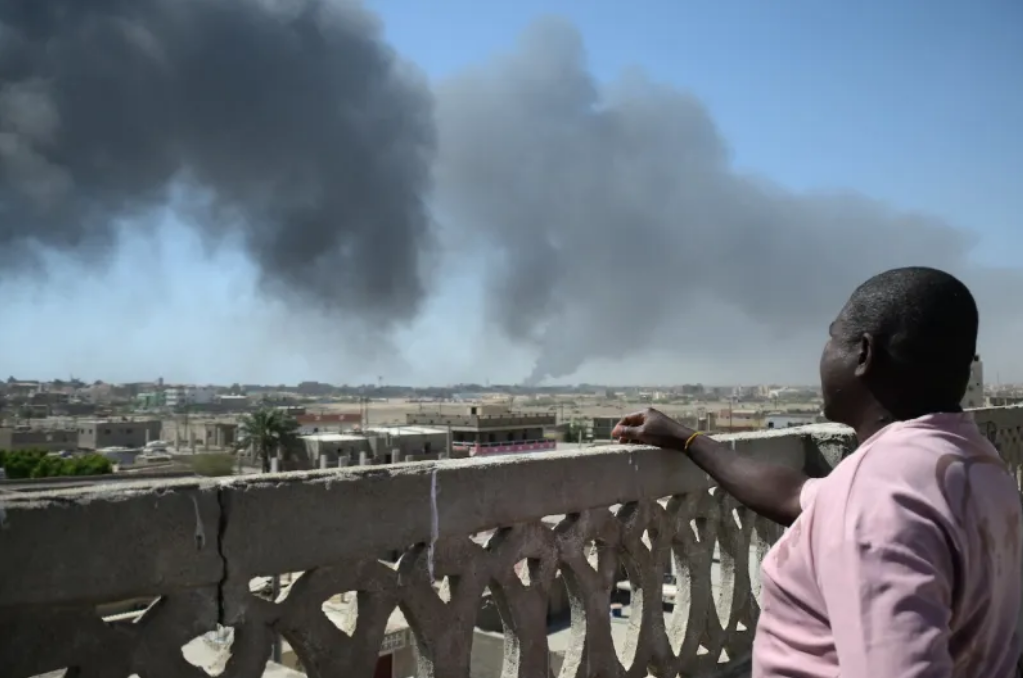
A man watches as smoke billows after a drone strike on Port Sudan, may 2025 (Photo: AFP - Getty Images)
The geographical distribution of the victims reveals that no region of Sudan was spared: North Darfur recorded 577 deaths attributed to drones, followed by West Kordofan (567), North Kordofan (548), Khartoum (403) and South Kordofan (396).
Among the most shocking episodes is the Kaluqi massacre in December 2025, when a drone struck a primary school in South Kordofan. Contrary to what one might imagine, the attack did not stop there: the first responders who arrived at the scene and the hospital where the victims were taken were also subsequently attacked. The UN documented 104 civilians killed in a series of attacks in the Kordofan region in a single week of that month.
Other equally serious incidents include the attack on the Abu Shouk displaced persons camp on September 19, 2025, which killed approximately 75 people; the attack on Dar al-Arqam in El Fasher on October 10, which left 60 dead; and an attack on a cluster of displaced persons in Samasim on the last day of 2025, with 41 fatalities.
The projectSudan WitnessThe organization that maintains the largest known database on military airstrikes in the conflict that began in April 2023 documents that the Sudanese army carried out bombing operations that killed at least 1,700 civilians in residential neighborhoods, markets, schools, and displaced persons camps. Mohamed Salahuddin, of the Emergency Lawyers' Association, counts approximately 129 drone strikes against civilian targets by both sides, resulting in 218 deaths and 112 injuries in 2024 and 2025 alone.
The UN High Commissioner for Human Rights, Volker Türk, has repeatedly warned of escalating hostilities and classified drone attacks on civilian facilities as potential war crimes. In a recent statement, Türk documented more than 90 deaths and 142 injuries between the end of January and February 6, 2026, the same period in which the army broke prolonged sieges in cities previously controlled by RSF.
Sudan as a laboratory
Retired General Walid Ezzedine Abdel Majid, a member of the Central High Command of Retired Officers, states that what is happening in Sudan represents the first African model of large-scale drone use in a civil war context. This statement is not hyperbolic: while drones have been used in other African conflicts, in Mali, Libya, and Ethiopia, the scale, technological sophistication, and variety of platforms employed in Sudan are unprecedented on the continent.
There is a lesson here that echoes debates already held since the wars in Syria and Ukraine: the democratization of drones. If before these devices were the privilege of military powers with large defense budgets, today any actor with access to international markets, formal or informal, can acquire unmanned aerial capability. In the case of RSF, the modification of commercial DJI drones for military use is a clear example of this trend: off-the-shelf technology, adapted in an artisanal way, capable of causing significant destruction.
Retired General Jamal al-Shahid points out that drones have become an indispensable part of modern warfare precisely because they combine low operating costs with the ability to strike precisely at long distances, something unfeasible for manned aircraft in many scenarios. However, he emphasizes an important limitation: drones can destroy, but they cannot occupy territory. Controlling areas still requires infantry.
This argument is corroborated by retired General Mutasim Abdel Qader, who observes that RSF resorts to drones especially when under ground pressure from the army, using them as a tool to compensate for losses in the field. The use of drones, therefore, does not replace ground force, but can be a multiplier of destructive capacity with devastating effects on civilian populations.
The illusion of military victory
Fouad Osman, a researcher of political affairs and the Horn of Africa, aptly summarizes the dilemma surrounding the conflict: since the beginning of the war, both sides have fueled the narrative that a military resolution is imminent. For Osman, this is a "costly myth," one of the greatest illusions that the parties try to instill in the public consciousness. The decision to stop the war, he argues, has become hostage to the consensus among supporters of both sides, and the massive use of drones has only increased the death toll and eroded the population's sense of security.
Osman's analysis resonates with classic literature on air power. Robert Pape, in his workBombing to WinHe argues that the success of bombing campaigns in obtaining political concessions depends on the strategy adopted: punishment, decapitation, or denial. In the Sudanese case, none of the strategies seems to be producing definitive results: the RSF continues to operate despite losses, and the army, despite retaking some cities, has failed to dismantle the enemy. The war continues, and the drones continue to fly.
As Osman concludes: despite all the destruction, there is still an opportunity to stop the war if the will for peace overcomes the “illusion of military victory.” The path of bullets, he says, is a dead end.
References
https://sudantribune.com/article/310795
https://sudantribune.com/article/313822
https://acleddata.com/conflict-watchlist-2025/sudan/
https://www.amnesty.org/en/latest/research/2024/07/new-weapons-fuelling-the-sudan-conflict/